The Big SEO Shift of 2026: Neo Breaks Down 7 Core AI & Search Trends
Hi everyone, this is Neo.
If 2024 was the year AI search was born, then 2026 is when we’re getting a full-blown “search revolution.”
SEO these days isn’t just about chasing Google rankings anymore. From ChatGPT to Perplexity, and Google’s own AI Overviews, the way users search is fundamentally changing. They’re no longer just typing keywords and clicking through ten blue links — they’re having “conversations” with AI and getting answers directly.
What does this mean for us Chinese sellers running independent sites? It means your competition isn’t just other brands anymore — it’s AI itself. If AI can’t “understand” your website, or doesn’t treat your brand as an “authoritative source,” you could vanish from the traffic game entirely.
Lately, I’ve been digging into what major overseas media are saying about enterprise SEO and AI trends for 2026, and combining that with my own hands-on experience, I’ve boiled it down to 7 core trends. Hopefully this helps you see where things are heading and plan ahead.
1. Technical SEO: The “Infrastructure” of the AI Era
We used to do technical SEO so Googlebot could crawl our pages. In 2026 that’s still the baseline, but the goal has changed: we need AI agents to be able to “read” your site.
This is what people mean by the “Agentic Era.”
AI agents (like GPTBot and ClaudeBot) don’t just index content like traditional crawlers — they “read” and “extract” information on behalf of users in real time. If your site loads slowly, has messy structure, or is all JavaScript-rendered content, AI agents may just skip right past it.
Neo’s advice: Think of technical SEO as the “translation layer” between your content and AI systems.
- Schema Markup: This is the most important piece. Through Schema, you tell AI: this is the product price, these are user reviews, these are the detailed specs. It’s the “machine language” AI can directly quote.
- LLM Friendly: Make sure your core content is readable as plain text — don’t hide important information inside images or complex scripts.
2. Content Quality: “Real Human Experience” Becomes Your Biggest Moat
AI can generate ten thousand words in a second, but it has one fatal weakness: it has no body, no real lived experience.
That’s our opportunity. In 2026, search engines and AI engines will heavily reward content with unique insights, real case studies, and a “human touch.” This is what Google has been pushing with E-E-A-T (Experience, Expertise, Authoritativeness, Trust).
AI tools won’t cite content that’s just a rehash of existing information (because it can stitch that together itself) — it will only cite sources: the content that offers unique data, perspectives, or stories it doesn’t already know.
Neo’s advice:
- Refuse to be mediocre: Stop writing encyclopedia-style articles like “What is SEO.”
- Tell stories: Write in the first person with “I” — share real client stories, failures, and wins.
- Publish original data: Release your own industry surveys and user data analysis. That’s the hard currency AI can’t fabricate out of thin air.
3. The Rise of Visual & Multimodal Search
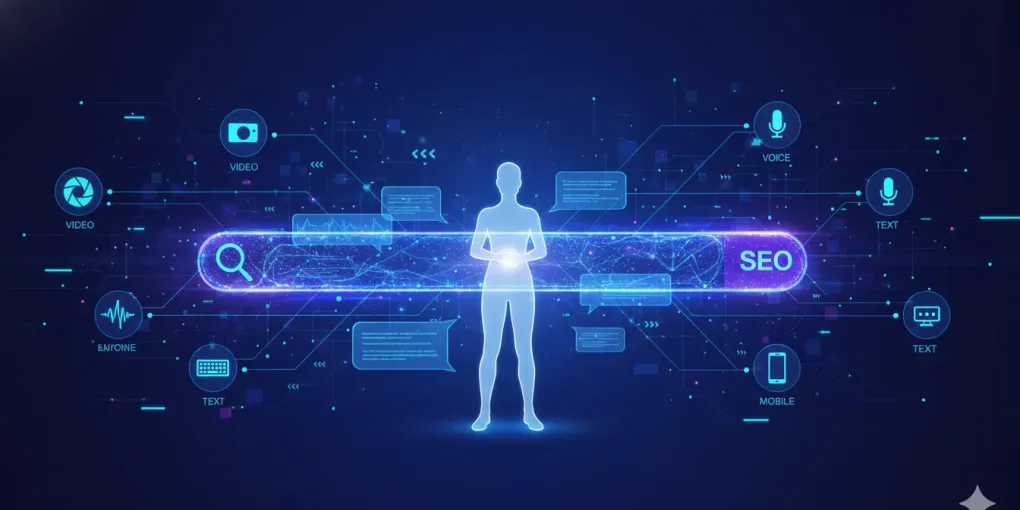
Have you noticed? Search isn’t just typing anymore. Voice search, image search (Google Lens), and video search are going mainstream. This is multimodal search.
Here’s a stunning stat: citations from YouTube inside AI Overviews grew by 121%!
That means if your independent site is nothing but dry text, you’re missing out on a massive traffic entry point. Video and images aren’t just for users — they’re for AI to “see” too.
Neo’s advice:
- Video First: Turn your blog posts into YouTube videos.
- Image optimization: Don’t just upload images — add detailed Alt Text and structured data so AI knows exactly what product is in the photo and what details it shows.
4. Brand Authority: From “Presence” to “Perception”
We used to measure SEO success by rankings and traffic. But in the AI era, we need to track a new metric: Share of AI Conversation.
What does that mean? When a user asks AI “recommend a few tents for camping,” will AI mention your brand? And if it does, how does it describe you — “great value” or “questionable quality”?
This is the shift from “presence” to “perception.” An LLM is essentially a giant “reputation engine” — it forms an “impression” of your brand based on everything it finds on the internet.
Neo’s advice:
- Track your mentions, not just links. AI can read sentiment.
- Work hard to become a cited source. When industry media and KOLs are all talking about you, AI will naturally treat you as an authority.
5. “Search Everywhere”
The definition of “SEO” is expanding without limits. It used to be SEO = Google Optimization. Now, SEO = Search Everywhere Optimization.
Users search for tutorials on TikTok, reviews on Reddit, advice on ChatGPT, and products on Amazon. Every platform is a search engine, and every platform needs SEO.
Neo’s advice:
- Go omnichannel: Don’t just focus on Google. Your content needs to be distributed across Reddit, Quora, YouTube, LinkedIn, and more.
- Adapt to each platform’s context: On Reddit, talk like a real person. On LinkedIn, stay professional. On TikTok, be entertaining.
6. Digital PR: The “New Link Building” of the AI Era
Traditional link building is evolving into digital PR.
BrightEdge data shows that 34% of AI citations come from PR-driven media coverage.
Why? Because when LLMs are trained, the highest-weighted corpora are authoritative news outlets, industry journals, and well-known blogs. If your brand shows up in those high-authority outlets, AI stamps your brand with a “highly trustworthy” label.
Neo’s advice:
- Build media relationships: Reach out to industry journalists and offer valuable story leads or expert commentary.
- Establish expert status: Position your founders or experts as thought leaders — take interviews, publish opinions.
7. Automation: A Must-Have for Scaling
Last point is about efficiency. With so many platforms and so many content formats, doing SEO entirely by hand is no longer possible.
Automation is no longer a nice-to-have — it’s survival. You need AI tools to monitor your brand’s performance across AI platforms, automation tools to check technical issues on your site, and AI to help draft content.
Neo’s advice:
- Human + machine collaboration: Let AI do the grunt work (data analysis, first drafts, code checks) and let humans do what matters (strategy, emotion, creative control).
- Build SOPs: Standardize every process that can be automated, freeing up people to tackle the things AI can’t.
Summary
In 2026, the core logic of SEO has changed.
We’re no longer just trying to please Google’s algorithm — we’re winning the “trust” of AI systems through high-quality content, technology, and brand building.
For Chinese brands going global, this shift is both a challenge and an opportunity to overtake on the curve — because everyone is starting from the same line as they adapt to the “AI search era.”
Neo’s final take: No matter how the technology changes, “delivering value to users” never changes. The more advanced AI gets, the more scarce real human experience becomes. Build great products, tell great stories, and serve every real user well — that’s the ultimate essence of SEO.
Hope this article gives you some food for thought. If you found it useful, feel free to share it with fellow go-global founders.
References: