Your B2B Buyers Already Passed on You Before They Even Reached Out
Hi everyone, this is Neo.
Today I want to talk about a brutal reality that a lot of B2B independent site owners haven’t fully registered: by the time your sales team finally gets that inquiry and starts following up, the buyer has already crossed you off the list in their head.
This isn’t fear-mongering. 6sense’s 2025 Buyer Experience Report shows B2B buyers complete an average of 61% of their research before contacting a vendor. Gartner’s data is even more sobering — the average modern B2B purchase decision is made by a buying group of 11 people.
In other words, by the time a prospect emails you saying “I’d like to learn more,” their shortlist is already set. You’re not competing on a level playing field — you’re competing against a list that was decided without you.
In this post, I want to talk about how to occupy buyers’ minds during the phase where they can’t see you, and become the brand that makes it onto that list.
1. The buyer journey has changed: research first, contact second
The traditional sales funnel was linear: buyer searches → sees your site → fills out a form → sales follows up → deal closed.
That model is completely dead by 2026.
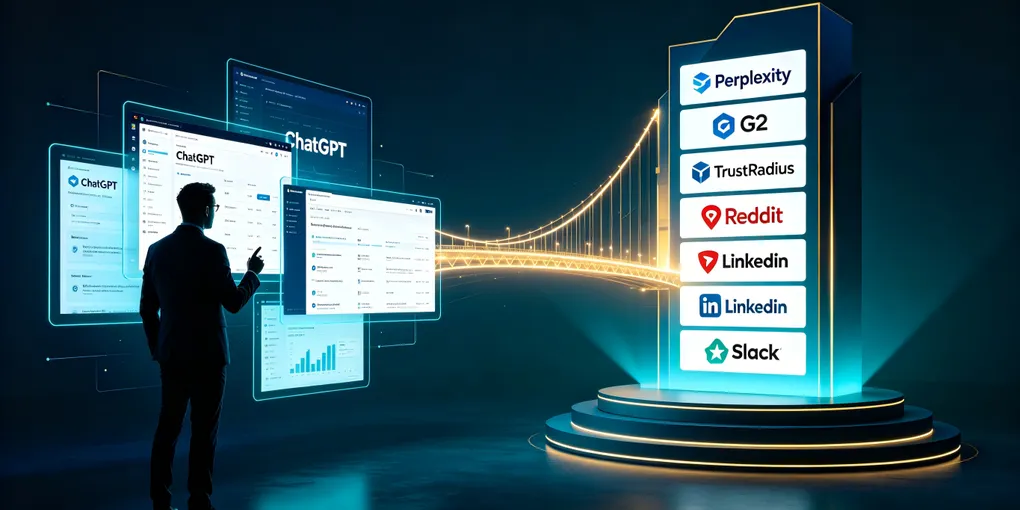
Here’s what the buyer journey looks like now:
- First, they ask around in AI tools (ChatGPT, Perplexity)
- Then they check real user reviews on G2 and TrustRadius
- They ask peers for honest experiences on Reddit, Slack groups, and LinkedIn
- They dig through code on GitHub and search integration issues on Stack Overflow
- Only at the end do they open your website — and usually they go straight to the pricing page
Your website may be the last stop on the buyer’s journey, not the first.
BrightEdge data shows that 90% of B2B buyers click the citation links in AI search answers. If your brand doesn’t show up in those AI answers, you don’t even get a chance to be seen.
Neo’s take: The biggest mistake B2B independent site owners make is pouring their entire budget into on-site SEO. Your website matters, sure — but buyers have already made up their minds before they ever land on it. Don’t wait for them at the finish line. You need to show up at the starting line of their research journey.
2. Strategy one: build cross-channel brand credibility
To make it onto the buyer’s shortlist, you need to show up at every touchpoint where they do research.
1. Win the citation slots in AI search (AEO & GEO)
AI search cites sources very differently than traditional SEO. Answer Engine Optimization (AEO) and Generative Engine Optimization (GEO) are now required coursework.
Practical checklist:
- Run an AI visibility audit: search your brand name and industry keywords in ChatGPT, Perplexity, Gemini, and Copilot, and see whether AI mentions you and how
- Track citation frequency: use tools to monitor how often your brand is cited in these AI engines and how that trend moves over time
- Structured data is table stakes: FAQ schema, HowTo schema, Organization/Product markup — all of it needs to be in place. It directly determines whether AI can “read” your site
- PR and comparison content are your nuclear weapons: AI engines love citing review-comparison articles and industry media coverage. Proactive PR and vendor comparison content outperform plain keyword rankings
2. Run your review platforms like a business asset
Reviews on G2 and TrustRadius carry more weight with B2B buyers than your sales deck ever will.
A few key points:
- Keep collecting real reviews: this isn’t a one-time surge of five-star ratings. Build a long-term mechanism — invite happy customers to leave reviews at key success milestones (three months after onboarding, before renewal)
- Mine competitor negative reviews: read what users complain about in competitors’ low ratings, then address those pain points directly in your product docs and case studies
- Reply to every single review: the good and the bad. You’re not replying for that reviewer’s sake — you’re replying for every future buyer who reads those reviews. It shows you care and you’re improving
- Map review content to journey stages: early-stage buyers need macro validation of product capability; late-stage buyers need concrete implementation and integration details
3. Build a real presence in peer communities
Reddit, LinkedIn groups, Slack communities, industry forums — this is where B2B buyers go for “real information.”
Don’t walk in and start posting ads. The right approach:
- Join discussions as a practitioner and answer technical questions
- Share how you solved a specific business pain point
- Mention your solution naturally when it fits — but the core is contributing value
Neo’s take: B2B buyers trust vendor claims less and less, and peer validation more and more. Your G2 rating, your reputation on Reddit, how often you’re cited in AI answers — together, that’s what “brand credibility” actually is. This isn’t just a marketing department problem. It’s a company-wide strategy that product, customer success, and engineering all have to be part of.
3. Strategy two: let every role in the buying group “verify” you on their own
B2B purchasing isn’t a one-person decision. A typical buying group includes a technical decision-maker, a business decision-maker, finance, security, operations — and an internal champion pushing everything forward.
Your content strategy has to serve all of them at once.
1. For technical buyers: self-service validation materials
Technical buyers will test your solution themselves before they ever talk to sales. They’re looking for integration code on GitHub, searching error messages on Stack Overflow, flipping through the API reference in your docs.
What you need to do:
- Provide complete, runnable code samples — not hello world, but production-ready examples
- Maintain an active GitHub project with real commits and responsive issue handling
- Answer product-related questions on Stack Overflow to demonstrate your technical support capability
- Offer a test environment or sandbox so technical buyers can try it at zero cost
- Security documentation must be complete: SOC 2, GDPR, data flow diagrams, independent security audit reports — none of it is optional
These materials have one goal: let technical buyers verify “this product works, works well, and is secure” without ever emailing sales.
2. For business decision-makers: ROI and third-party validation
CFOs and business leaders don’t care how good your API is. They care about:
- How long until payback
- How you stack up against industry benchmarks
- Whether there’s independent third-party validation
What you need to prepare:
- Commission independent research: hire a consulting or research firm to produce an industry report and include your solution in it
- Get into analyst evaluations: Gartner Magic Quadrants and Forrester Waves carry enormous weight with executive buyers
- Thought leadership on LinkedIn: not product features — insights on industry trends and thinking about customers’ business transformation
- Board-ready materials: translate technical capability into business outcomes, in language a CFO actually speaks
3. For the internal champion: an ammunition kit
The internal champion is your most critical ally. They have to convince other stakeholders when you’re not in the room.
Give your champion a complete “ammunition kit”:
- Objection responses tailored to each role:
- Finance: ROI models, TCO comparisons, cost-benefit analysis
- IT: integration complexity assessment, security and compliance checklists
- Security: compliance framework mapping, audit reports, data sovereignty notes
- Operations: change management plans, training programs, go-live timelines
- Executives: strategic alignment analysis, competitive positioning, industry trend support
- Demo templates for different scenarios:
- An executive summary for the C-suite (one page that says it all)
- A technical review for the architecture committee
- A business case for financial approval
- An adoption plan for the operations team
Neo’s take: Winning a B2B deal ultimately means giving your internal champion the ammunition to win internal meetings when you’re not there. The more complete, targeted, and copy-paste-ready your materials are, the higher their chances of pushing it through. A lot of B2B independent sites only create content aimed at end users and completely ignore the “internal seller” — that’s a huge miss.
4. Strategy three: build a measurable discovery system
You’ve done all this groundwork — how do you know if it’s working? You need a discovery analytics dashboard that quantifies “being found.”
1. AI visibility metrics
- Share-of-voice in AI responses: how often your brand is mentioned vs competitors in ChatGPT, Perplexity, Gemini, and Copilot
- Citation frequency trends: how often your domain is cited across these AI engines over time
- AI-sourced traffic attribution: can you track clicks that come from AI answers
2. Review platform metrics
- Review count trends, average rating, and ranking changes in key categories
- Your relative position vs competitors
3. Peer community metrics
- Brand mention volume and sentiment analysis on Reddit, Slack, and LinkedIn
- How often your brand gets recommended in community discussions vs competitors
4. Technical validation metrics
- GitHub stars, forks, and issue response speed
- Volume and quality of Q&A related to your brand on Stack Overflow
- Time on page and scroll depth on technical documentation pages
5. Business decision-maker metrics
- Downloads of executive-level content and the quality of leads generated
- Analyst report downloads and conversion rate into enterprise deals
6. Reverse attribution: trace winning deals back to discovery
The most valuable analysis works backward from customers you’ve already closed:
- Where did they first hear about you? (AI search, G2, Reddit, word of mouth?)
- What content touchpoints did they hit between “first discovery” and “reaching out”?
- Which channel combinations produce the highest-quality leads, shortest sales cycles, and highest win rates?
Neo’s take: The problem with most B2B independent sites isn’t that they don’t create content — it’s that they don’t know which content actually drives deals. Connect the discovery path to pipeline outcomes, and you’ll finally know where to spend budget. Stop looking at traffic in isolation; look at the full chain of “discovered → validated → selected.”
5. A note for B2C independent site owners
This post is about B2B, but the B2C logic is converging fast.
Consumers buying a coffee machine or choosing a skincare brand now follow a path that looks a lot like the B2B buyer:
- Ask AI first: “best home espresso machine recommendations”
- Watch real reviews on Xiaohongshu/TikTok/YouTube
- Search Reddit, Douban, and Zhihu for real user feedback
- Finally open Amazon or your independent site and go straight to the price
B2C independent sites need the same systematic presence across AI search, UGC platforms, review sites, and social media. Brand building plus multi-touchpoint presence is the answer for both B2B and B2C.
Neo’s take: Whether B2B or B2C, the rules of “being found” have changed. Your independent site is no longer a destination — it’s one node in your entire digital presence. Buyers form preferences in AI, in communities, on video platforms, and only then come to your site to validate. Once you truly get this, your whole marketing strategy changes.
Summary
Here’s what we covered today:
- B2B buyers have completed 61% of their research before contacting you — the shortlist is already set
- Building brand credibility means covering AI search (AEO/GEO), review platforms, and peer communities simultaneously
- Different decision-makers need different validation materials — technical buyers need code and docs, business buyers need ROI and third-party validation, internal champions need copy-paste-ready ammunition
- Build a discovery analytics dashboard to quantify the chain from “being found” to “closing”
- B2C independent sites are going through the same shift — multi-touchpoint presence is the universal playbook
In 2026, winning B2B buyers isn’t about waiting for them to come to you — it’s about showing up at the very start of their research. Discoverability is the revenue engine of this era.
Hope this gives you something useful. If you’ve hit practical problems applying this, I’d love to hear from you.