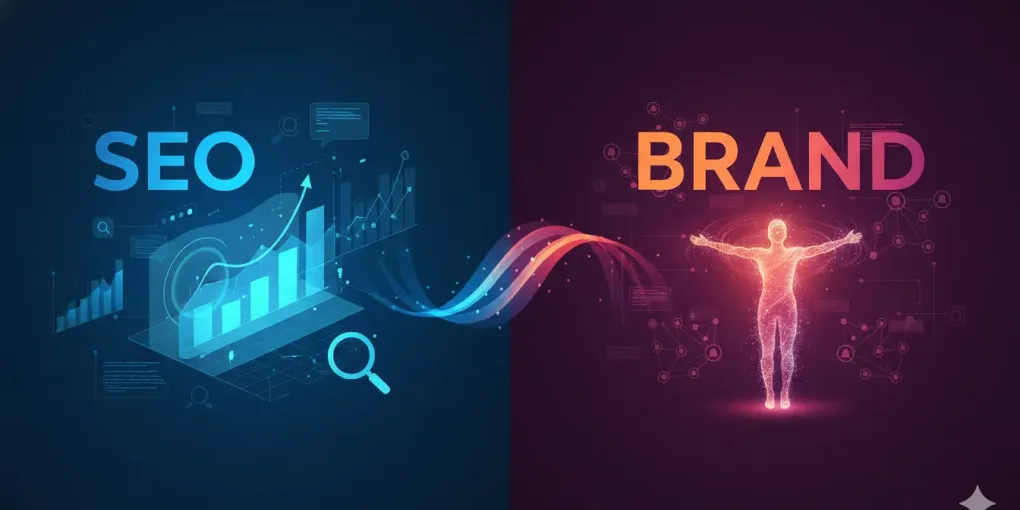
'Building a Brand' Isn't a Cure-All — It's Your Starting Point
Hi everyone, this is Neo.
Over the past year, whether you run a B2B or B2C e-commerce site, you’ve probably heard this advice a hundred times: “Build a brand.”
Traffic sliding? “Build a brand.” AI search (SGE) arrived and your traffic is getting siphoned off? “Build a brand.” SEO rankings swinging wildly? “Build a brand.”
It’s treated like a cure-all — the diagnosis and the prescription rolled into one. But here’s the thing: that advice isn’t wrong, it’s just incomplete. For a lot of site owners stuck in “traffic thinking,” it’s like being told “you need to get healthy” without any idea which medicine to take or how to train.
Plenty of operators — especially SEO folks with a technical background — can rattle off crawling, indexing, keyword mapping, and link building in their sleep. But ask them how demand actually arises, or how a brand takes root in a customer’s mind, and you’ll usually get blank stares.
So today, I want to break this down: when we say “build a brand,” what are we actually talking about? And why is “building a brand” not an endgame strategy, but only a starting point?
1. Face Reality: SEO Reaps Demand, It Doesn’t Plant It
A lot of founders and operators buy into the myth that if you just do SEO well, customers will keep lining up to buy your products.
Wrong. Dead wrong.
At its core, search has always been a demand capture channel, not a demand creation channel.
SEO rarely makes someone want something they’ve never heard of and never asked for. What SEO does is put your brand in front of a user who already has intent and is actively hunting for a solution — so you can win their heart at the exact moment they decide.
Neo’s take:
Don’t rely on SEO to “educate the market” or “create demand” — that’s the job of paid ads, social media, and PR. SEO’s core mission is to show up — when a user has a need, make sure you’re in the room.
2. Mental Availability: SEO’s Real Battlefield
So if SEO can’t create demand, what does it actually do for branding?
The answer: it builds mental availability.
That sounds academic, but it’s dead simple. When you keep showing up across tons of non-branded queries, your site plants a series of “touchpoints” in people’s minds.
For example, the first time someone searches “best running shoes,” they see you. The second time they search “how to maintain running shoes,” they see you again. The third time they search “trail running shoe recommendations,” there you are again.
Over time, that repeated exposure moves you from “stranger” to “familiar,” then from “familiar” to “preferred,” and finally to “loyal.”
The most important phrase here is: “over time.”
Trust and loyalty aren’t built overnight. No SEO tactic — black hat aside, which is just suicide — can instantly convert visibility into trust. It’s a long game.
A case in point:
The source article mentions Cloudflare. Back in 2017, they launched a “Learning Center” content hub — not to sell products directly, but to solve users’ problems. A few years later, that section had amassed millions of organic visits and over 30,000 backlinks. That’s the power of compounding. Every impression adds points to your brand; every return visit cements the perception.
Neo’s take:
If you run an e-commerce site, patience is a basic survival skill. Stop chasing “viral hits” and start chasing compounding growth. Building a brand is like saving money — SEO is how you keep depositing “trust coins.”
3. Content and Digital PR: Visibility Is a Means, Not the End
“Content is king” and digital PR are often called the two horses pulling the branding carriage. True — but way too vague.
Google’s stance is crystal clear these days: a solid technical foundation is the entry ticket; content and PR are the signals.
Content and PR aren’t just there to look good. They’re there to signal to search engines: crawl me deeper, show me more often.
But here’s a huge trap: thought leadership without an audience is just a vanity project.
I’ve seen too many brands going global spend a fortune on “lofty” industry insights and CEO vision pieces — and when you check the numbers, nobody reads them. If nobody consumes your content, it isn’t thought leadership. It’s internal self-congratulation.
Neo’s take:
Content should be built with a user mindset, not a boss mindset. The content that actually builds a brand is rarely grand strategy manifestos — it’s the practical, authoritative, genuinely problem-solving stuff. When your content reliably answers the questions users have at the moment they need answers, brand equity builds itself.
4. The Balancing Act: Brand Is the Result, Visibility Is the Mechanism
The challenge today isn’t choosing between “building a brand” and “driving traffic (visibility).” It’s learning to balance both.
- Brand is the result of the user experience.
- Visibility is the mechanism that lets those experiences scale.
You can’t swap one for the other.
For those of us running e-commerce sites, that means breaking out of a single-channel SEO mindset. You need to know not just how to create, but how to distribute; not just ranking signals, but brand stories.
Wrapping Up
The future of e-commerce doesn’t belong to people who just shout “I want to build a brand.”
It belongs to the ones who understand how visibility compounds, how trust is built step by step, and how SEO fits into a broader marketing system.
“Building a brand” isn’t the final answer to every problem — it’s where the real work begins once you finally start asking the right questions.
I hope this post gives you a little light if you’re feeling lost right now.
References: