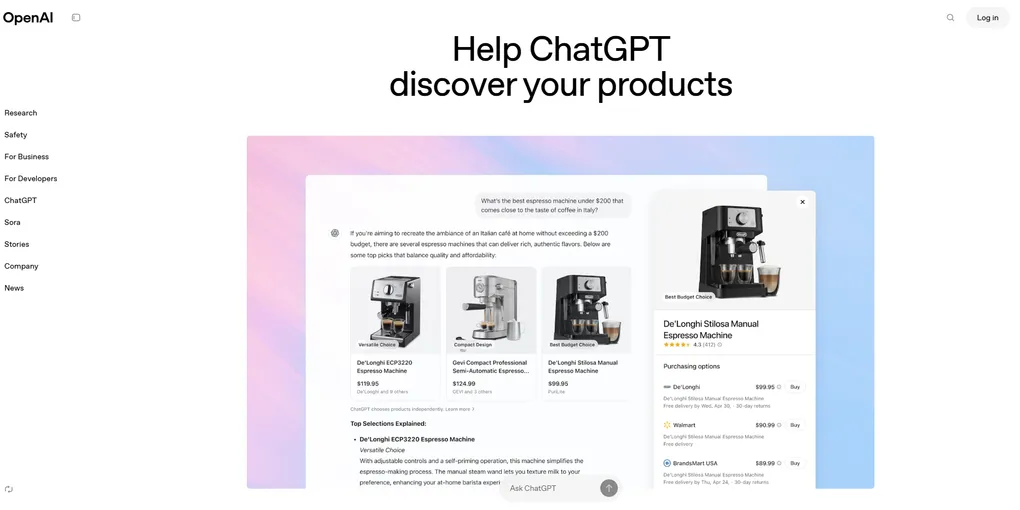
ChatGPT's Product Discovery Feature
Fellow independent site owners — isn’t traffic and exposure the thing that keeps you up at night? We pull every SEO trick, we run ads, all so more potential customers can see our products.
OpenAI’s new Product Discovery feature lets ChatGPT recommend products directly in conversation. That means when a user asks ChatGPT something like “I want to buy a gift for a friend who loves cooking” or “best noise-cancelling headphones under $200,” your product could get recommended directly!
The key thing: this is not advertising! It’s purely algorithmic, based on the relevance and quality of your products.
Today, let’s dig into this feature and — more importantly — how we as independent site sellers can seize this opportunity to get free exposure for our products inside ChatGPT.
What Is ChatGPT’s Product Discovery Feature?
In simple terms, ChatGPT just turned into a super-smart shopping assistant.
With traditional e-commerce search, users have to type precise keywords like “red dress size M.” But in the early shopping phase, a lot of people have vague, fuzzy needs.
ChatGPT’s new feature is all about being “conversational” and “intelligent.”
Users can describe their needs in completely natural language, like:
“I need a comfortable pair of shoes for standing all day, budget under $100, and they have to be breathable.”
ChatGPT fully understands this kind of complex, colloquial request — and then, like an experienced salesperson, it doesn’t just recommend the most relevant products, it tells you why it’s recommending them.

Under the hood, this is powered by the GPT-4 model and vector database technology. ChatGPT converts your product descriptions, specs, images, and other info into a string of numbers (a “vector”). When a user query comes in, it hunts through the massive pool of product vectors to find the closest matches.
How Do We Get Our Products Recommended by ChatGPT?
So — how do we actually get our products into ChatGPT’s recommendation list?
The opportunity is fair game: big brand or small seller, everyone’s got a shot. It comes down to two things: let ChatGPT “see” your products, and let ChatGPT “understand” your products.
Concretely, here’s what we need to do:
1. Make Sure ChatGPT’s Crawler Can Access Your Site
This is the most basic and most important step.
ChatGPT has a dedicated crawler for discovering and indexing web content, called OAI-SearchBot. If your site blocks this crawler, nothing else matters.
So go check the robots.txt file in your site’s root directory right now, and make sure it doesn’t contain anything like this:
User-agent: OAI-SearchBot
Disallow: /
The right move is to allow it to crawl — or simply not mention it in robots.txt at all. If you’re unsure, you can set it to allow all crawlers:
User-agent: *
Allow: /
Important note: OAI-SearchBot is only used for search and product discovery — it will not use your site’s content to train OpenAI’s models. You can rest easy on that front.
2. Optimize Your Product Pages and Structured Data
Letting the crawler in is just step one. The bigger deal is helping it “understand” your product information.
That means your product pages need detailed, clearly written content. And I strongly recommend using Schema.org structured data to mark up your product info.
For example, use the Product schema to explicitly tell search engines and AI the price, stock status, color, size, materials, and so on.
{
  "@context": "https://schema.org/",
  "@type": "Product",
  "name": "Example Product Name",
  "image": "https://example.com/product.jpg",
  "description": "This is a great product.",
  "brand": {
    "@type": "Brand",
    "name": "Example Brand"
  },
  "sku": "EX12345",
  "offers": {
    "@type": "Offer",
    "url": "https://example.com/product-page",
    "priceCurrency": "USD",
    "price": "29.99",
    "availability": "https://schema.org/InStock",
    "itemCondition": "https://schema.org/NewCondition"
  }
}
The better your structured data, the more precisely AI can understand your product — and the higher your recommendation success rate.
3. Watch Your Traffic Sources and Keep Optimizing
When a user lands on your site via a ChatGPT recommendation link, the link automatically carries a UTM parameter: utm_source=chatgpt.com.
You can monitor this traffic source specifically in Google Analytics or your other analytics tools. By analyzing these users’ behavior and conversion rates, you’ll learn which products ChatGPT favors — and reverse-engineer improvements for your product descriptions and marketing strategy.
4. Submit a Product Feed (Coming Soon)
OpenAI is also testing a more direct approach — letting merchants submit product data feeds, similar to a Google Shopping feed.
That feature isn’t live yet, but they’ve already opened up an interest form. I strongly recommend everyone fill it out and get in line. The moment it opens, you’ll be able to feed the freshest, most accurate product info directly to ChatGPT.
Sign up here: https://openai.com/chatgpt/search-product-discovery/
Why Should We Get Started Now?
I know — when something new shows up, everyone waits to see how it plays out. But this time, I genuinely believe the earlier you move, the bigger the edge.
- A brand-new free traffic channel: This is a fresh, high-potential organic traffic entry point. Get in now while the competition is still thin.
- Ultra-high-intent customers: Users who describe their needs in natural language usually have very clear buying intent. The conversion rate of this traffic should, in theory, beat traditional search.
- First-mover advantage: While your competitors are still figuring out what AEO (Answer Engine Optimization) even means, you’ll already be taking orders from AI conversations.
Bottom line: AI is reshaping how we do business — from content creation to customer service, and now extending into product discovery.
Conversational search isn’t just a minor technical update. It’s a shift in mindset. Users are no longer “searching” — they’re “conversing.”
As merchants, we have to shift our thinking too. No more simply stacking keywords — we need to think about how to weave our products naturally into that “conversation.”
Get moving: check your robots.txt, optimize your product pages, get in line at OpenAI. This brand-new blue ocean of traffic is worth exploring.
Reference links:
- OpenAI official page: https://openai.com/chatgpt/search-product-discovery/
- QAPLA’s Blog: https://www.qapla.io/blog/en/chatgpt-product-search/
- Profound’s Guide: https://www.tryprofound.com/guides/get-your-product-discovered-in-chatgpt-shopping