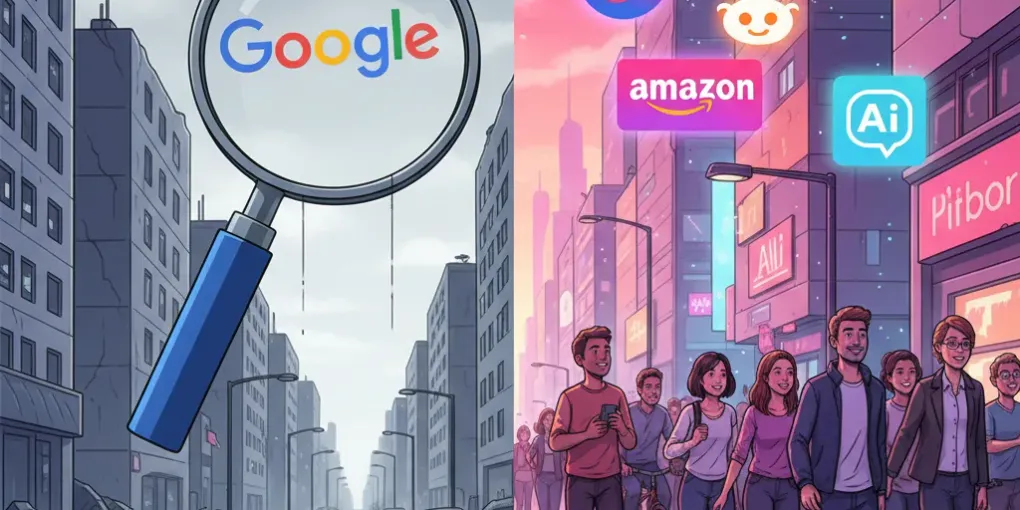
Your Customers Are Making Decisions Somewhere Else
Hey, site owners and bosses — this is Neo.
Have you ever been stuck in this puzzle: your website traffic keeps climbing, keyword rankings keep rising, yet your conversion rate and sales stay frozen solid? All those Google rankings you poured resources into optimizing seem to be a bustling but empty “traffic ghost town.”
Where’s the problem? The answer might sting a bit: your customers are making decisions somewhere else.
That’s what I call the “Google trap” — we pour our hearts into optimizing Google visibility, while consumers hunt for inspiration on TikTok, seek honest reviews on Reddit, compare prices and order on Amazon, and even ask ChatGPT for buying advice. When 73% of modern “searches” have moved outside Google, clinging to traditional SEO is like trying to sail a boat by scratching a mark on its side. We’re riding the biggest wave of decision-scene migration in internet history — the era of “rankings equal revenue” is over.
I. The Old Order Is Crumbling: Rankings ≠ Revenue, Traffic ≠ Conversion
Traditional search engine marketing (SEM) rests on a clear, direct assumption: improve Google rankings → get more traffic → drive more conversions and revenue. This seemingly solid logic chain has now snapped at the critical “traffic → conversion” link. A flood of incoming traffic may be nothing more than “passers-by” in the information-gathering stage, not “buyers” on the edge of a decision. The center of gravity for actual purchase decisions has systematically shifted.
The data shows that up to 73% of product search journeys start outside Google (Insider Intelligence, 2023). More critically, the final step of the consumer journey — that crucial “moment of decision” — increasingly happens inside social media, community forums, e-commerce platforms, and conversational AI interfaces:
- Confusion stage → Google: “What is a wireless noise-cancelling headphone?” (information gathering)
- Exploration stage → YouTube/TikTok: “AirPods Pro 2 vs Sony WF-1000XM5 in-depth review” (feature comparison, visual experience)
- Validation stage → Reddit: “Real user reviews: Is the noise cancellation on AirPods Pro 2 really weaker?” (community opinions, honest feedback)
- Decision stage → Amazon/brand site: “Check final price, deals, stock; read the latest user reviews” (purchase action triggered)
- Alternative path → ChatGPT: “I commute a lot and need strong noise cancellation and comfort. My budget is around $300. Recommend a few headphones and explain why.” (personalized, conversational decision support)
If your conversion stagnation happens at the “validation” and “decision” stages of the consumer journey, then no matter how dazzling your Google visibility (the journey’s starting point) is, it’s like sprinting on a broken bridge.
II. The New Search Landscape: The Fragmented Revolution of Decision Scenes
“Search” itself has fundamentally transformed — it now reaches far beyond the narrow act of typing keywords into a Google search box. It’s broader, more hidden, and more tied to specific needs and immediate contexts. Understanding these new forms of “search” is the key to breaking through:
1. Discovery Search — Home turf: TikTok / Instagram Reels / YouTube Shorts
- Scene: Users may have no clear purchase goal. They passively discover interests or solutions through immersive short-form video. Algorithmic recommendations play the central role.
- Example: A user scrolling TikTok sees a creative video demo of “small apartment storage hacks” and instantly sparks interest and need. Brands occupy users’ minds through high-quality, eye-catching short video content.
- Brand playbook: Create native short videos with high value, entertainment, or strong educational content; ride popular challenges and hashtags; partner with niche KOCs to reach precise audiences; optimize video titles, descriptions, and hashtags for in-platform search.
2. Community Validation Search — Home turf: Reddit / niche vertical forums
- Scene: Users have a clear product or problem in mind and turn to specialized communities or interest groups for genuine, unbiased opinions, shared experiences, and collective wisdom. Trust is built on consensus among “people like us.”
- Example: Before buying a gaming laptop, a user posts in Reddit’s r/GamingLaptops: “Budget $1500, mainly for AAA games. Lenovo Legion 5 Pro or Asus ROG Strix G15? Need real user experience!” Detailed replies and votes from other users directly influence the decision.
- Brand playbook: Participate in relevant community discussions actively and sincerely (no hard selling); set up official accounts to respond to user questions promptly; encourage real users to share experiences; monitor brand/product discussions and help where appropriate; support KOLs in core communities.
3. Transactional Decision Search — Home turf: Amazon / brand sites
- Scene: Users are in the final decision stage. They need to compare specific models, prices, promotions, and stock — and they rely heavily on other users’ reviews (text, images, video) for final purchase confirmation.
- Example: A user decides to buy a cordless vacuum from a certain brand. On the Amazon detail page they compare model specs back and forth, focusing on the latest negative reviews (especially ones about battery life and suction decline), and finally pick the model with fewer complaints and better value.
- Brand playbook: Optimize product pages to the extreme (detailed specs, high-res images/videos, clear USPs); actively manage reviews (respond to negative ones promptly, encourage satisfied customers to leave reviews); offer competitive pricing and promotions; ensure accurate stock and efficient logistics; use in-platform ads to precisely reach hesitant users.
4. Conversational/Intelligent Search — Home turf: ChatGPT / Claude / Perplexity / New Bing
- Scene: Users get personalized advice, deep comparisons, and decision support through natural-language conversation. AI assistants synthesize web information (potentially bypassing traditional SEO rankings) to deliver tailored answers.
- Example: A user asks ChatGPT: “I need a lightweight laptop for a colleague who travels a lot, handles many documents, and does some light design work. Budget is around $1200, with good battery life. Recommend 3 models with a detailed comparison of pros and cons.” ChatGPT’s answer serves up a pre-digested comparison of options.
- Brand playbook: Make sure your brand and product info is accurate and rich on authoritative sites (Wikipedia, professional review media, major news outlets); optimize Knowledge Graph information; explore using AI tools for personalized customer service or product consultation; monitor how your brand gets mentioned in AI-generated results.
Core insight: users’ search behavior is driven by their specific intent (learning, entertainment, socializing, comparing, buying, getting advice) — not by loyalty to any search engine. Marketers must follow where user intent flows, not cling to a single channel.
III. The Way Out: Embrace Omni-Channel Search Presence Optimization
Escaping the “Google trap” isn’t about denying Google’s value — it’s about adopting a bigger, sharper channel strategy. The core thinking here draws heavily from SEO giant Neil Patel’s insights; his personal site once generated a staggering 7 million monthly visits. He calls this new methodology OSPO (Omni-Channel Search Presence Optimization). Its core idea: actively build a strong, credible, high-value presence at every key step of the user’s decision journey — especially in the “validation” and “decision” scenes where they ultimately commit.
The Four Core Pillars of OSPO:
-
Map a precise user decision journey:
- Go beyond demographics: Deeply understand how your target customers typically think, what doubts they hold, and which information sources they prefer when buying products like yours.
- Key questions: Where do they first learn about this type of product? Where do they do comparison research? Whose opinions do they trust most on which platforms? Where — and based on what information — do they finally hit the “buy” button?
- Methods: Customer interviews, surveys, data analysis (multi-touch attribution — imperfect but worth attempting), social listening, user journey mapping tools.
-
Go deep on platforms: build trust strongholds at core decision points (Trust over Reach):
- Core principle: Building deep influence and trust on 1-2 platforms that matter most to your target customers’ decisions is worth far more than skimming exposure across 10 platforms.
- How to choose: Based on your user decision map, pick the platforms that carry the most weight in the “validation” and “decision” stages (it could be TikTok + Amazon, or Reddit + niche forums + your site).
- Deep strategies:
- TikTok/short video platforms: quality native content that solves pain points, shows results, and stirs emotion; partner with real users and micro-influencers; steer traffic to seeding communities or purchase points.
- Reddit/community platforms: participate sincerely, professionally, and consistently; help without asking for anything; run an official account as a reliable source of info; never push hard sales.
- Amazon/e-commerce platforms: treat review management as your lifeline!; optimize detail pages to the extreme; use promotions and ads to lock in high-intent users; deliver outstanding customer service (to reduce the sources of negative reviews).
- ChatGPT/AI platforms: make sure your brand’s baseline info (official site, encyclopedia entries, authoritative coverage) is accurate and rich; explore AI customer service and personalized recommendation applications.
-
Adapt content: build value vehicles that fit each platform’s DNA and user intent:
- Key shift: from “keyword stuffing” to “intent satisfaction” and “value delivery.”
- Platform-specific tailoring:
- TikTok: short, fast, hook-first, strong visual impact, native music/effects.
- Reddit: deep, expert, authentic, candid (don’t hide flaws), genuinely helpful.
- Amazon: detailed, clear, real (photos/videos), highlight differentiated advantages, social proof (reviews).
- ChatGPT: structured, factually accurate, authoritative sources, covering common Q&A scenarios.
- Core content types: in-depth reviews, authentic experience shares (UGC/PUGC), pain-point solutions, product comparison guides, expert Q&A, how-to tutorials, customer testimonials.
-
Redefine measurement: track validation and decision influence:
- The pain point: the traditional last-click attribution model is completely broken.
- Advanced strategies:
- Platform-level conversion tracking: use tools like the TikTok Pixel, Reddit Conversion API, and Amazon Brand Analytics to track user behavior on each platform through to conversion.
- Diversified attribution models: explore position-based and time-decay attribution to more fairly credit each touchpoint.
- User research and attribution surveys: directly ask users which channels most influenced their final decision.
- Shifting core metrics:
- Exposure metrics (beware the trap): rankings, impressions, total traffic.
- Validation & decision metrics (focus here): engagement on core decision platforms (comments, shares, saves), user-generated content mentions/sentiment, add-to-cart rates on e-commerce platforms/your site, conversion rates, the quantity and quality of user reviews, the rate/accuracy of brand recommendations in AI-generated content like ChatGPT.
- Ultimate metrics: customer acquisition cost (CAC), customer lifetime value (LTV), sales, profit.
IV. Exposure vs. Validation: Trust Is the Ultimate Currency of Conversion
The essence of the “Google trap” is confusing “being seen” (exposure) with “being believed” (validation) — two wildly different things.
- Exposure: getting your message in front of as many eyes as possible (like high Google rankings or display ads). It’s the journey’s starting point — necessary but far from sufficient. It solves the “knowing” problem.
- Validation: the core process where users assess credibility, seek third-party opinions, compare options, and build purchase confidence. It happens in TikTok review videos, heated Reddit threads, Amazon’s dense review sections, and ChatGPT’s seemingly objective analyses. Validation directly decides whether a user moves from “interested” to “buying.” It solves the “trust” and “choosing you” problem.
In an era of information overload, scarce user attention, and widespread distrust, the power of validation far outstrips bare exposure. One honest negative review can easily destroy the goodwill built by ten perfect ad impressions. The essence of omni-channel search optimization is strategically investing your resources in the decision scenes that most powerfully build user trust and provide strong validation.
V. The Future Is Already Here: The AI Search Revolution Keeps Evolving
Conversational search powered by large models like ChatGPT is accelerating the transformation of how we get information and make decisions:
- Aggregation and summarization: AI serves answers directly, skipping the traditional 10 blue links and eroding traditional SEO’s visibility.
- Personalized decision support: AI deeply understands user needs and delivers tailored buying recommendations — a powerful “shopping assistant.”
- Challenges and opportunities coexist: brand information needs to be more structured and semantic so AI can accurately understand and cite it (Knowledge Graph optimization). Meanwhile, exploring AI tools to improve customer service and marketing efficiency becomes a new frontier.
Omni-channel search optimization isn’t a one-time project — it’s a dynamic process that demands continuous monitoring, analysis, and iteration. User behavior, platform algorithms, and emerging channels (like AR/VR shopping exploration) keep evolving.
Conclusion: From the Traffic Fortress to the Trust Stronghold
The “Google trap” alarm keeps ringing: when your traffic reports look glossy while conversions stay silent, don’t get drunk on false prosperity. Your customers stopped pressing the confirm button there a long time ago. They’re drawing inspiration in TikTok’s ocean of creativity, seeking answers in Reddit’s sincere discussions, validating choices in Amazon’s review sections, and even consulting smart AI assistants for expert buying advice.
The key to breaking through lies in deeply understanding the paradigm shift of “search”, embracing the strategic thinking of “omni-channel search optimization”, and grasping the trust economics where “validation beats exposure”. Stop obsessing over Google ranking numbers. Grab your “user decision map,” focus on the core battlefields that truly breed trust and catalyze decisions (TikTok, Reddit, Amazon, AI platforms…), invest resources to work them deeply, and build a trust stronghold that’s hard to shake.
Take action now:
- Map your own decision journey: where exactly do your customers complete “trust validation” and “final decisions”?
- Choose 1-2 core battlefields: focus your resources, dig deep into trust (reviews, communities, in-depth content), and reject traffic bubbles.
- Re-examine your content strategy: tailor content formats and core messages to each decision scene (pain-point solutions, honest testimonials, deep comparisons).
- Rebuild your measurement system: kill vanity metrics and focus on “validation engagement,” “review influence,” and “decision conversion rate.”
This great migration of internet user decision scenes has destroyed the old order — and it’s breeding opportunities for new kings. It’s time to walk out of the traffic fortress of the “Google trap” and build your trust empire in the wide-open territory of omni-channel search. The future belongs to the brands that hold the trust high ground wherever users truly make their decisions.
Reference links:
- https://www.youtube.com/watch?v=39o0uYPo4jU
- https://www.engagingpartners.co/blog/omni-channel-marketing-complete-guide-2024
1 - https://firework.com/blog/omnichannel-statistics
2 - https://www.adogy.com/terms/omnichannel-presence/
3 - https://www.invoca.com/blog/do-you-know-the-four-pillars-of-omnichannel-marketing
4 - https://sekel.tech/blog/10-best-omni-channel-strategies-with-examples
5