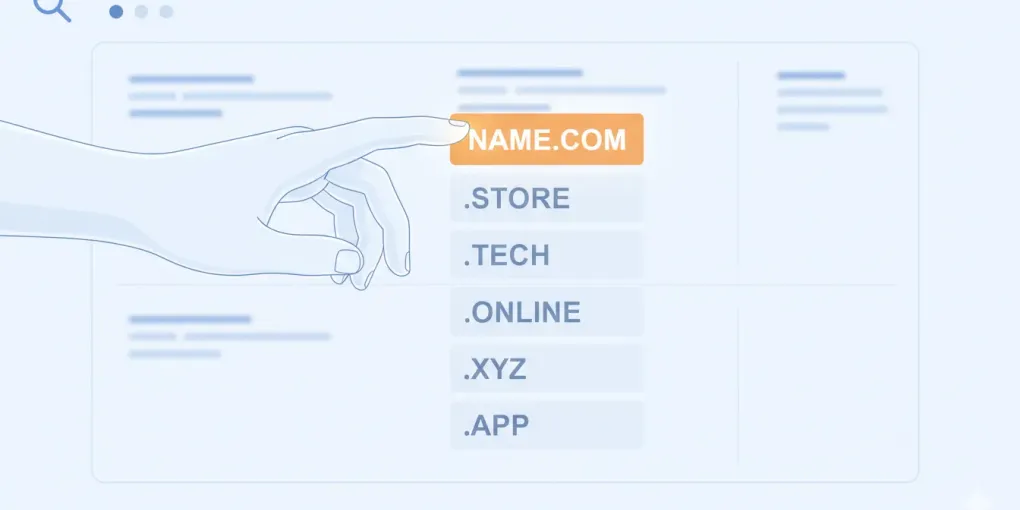
.com Taken? Will Using a .store or .tech Domain Hurt Your Google Rankings?
Hi everyone, this is Neo.
A friend in the auto parts B2B space recently asked me: his company wants to launch an independent site, but the .com domain they wanted was registered long ago. He noticed, though, that some TLDs with industry keywords — like .parts or .industry — seemed available. He’s torn: those domains look like a perfect fit, but do they actually help with Google SEO? Could they backfire?
This is a great question, because almost every independent site owner runs into it. Today, drawing on my own hands-on experience, I’m going to settle it once and for all: is a keyword-bearing domain extension (what we call a gTLD) actually a good deal?
What Does Google Officially Say? A Cold Shower
First, let’s hear from the “referee.” Google’s John Mueller — that bald guy always popping up to answer SEO’s thorniest questions — has been crystal clear:
“Using domain extensions like .music or .parts offers absolutely no SEO advantage.”
In short, your site does not get ranking points just because its extension contains a “keyword.” In Google’s algorithm’s eyes, .com, .parts, and .store all start from the same line when it comes to ranking weight.
Feeling a little deflated? Hang on — that’s only half the story. Google’s algorithm is rigid, but the people searching and buying are alive.
My Practical Take: Don’t Just Play “Machine SEO” — Play “Human SEO”
After years of running independent sites, I’ve found a truth: top-tier SEO is, at its core, “user experience optimization.” Your website ultimately serves people, not Google’s crawler.
From that angle, a meaningful domain extension can’t directly please Google, but it genuinely can “please” your potential customers. I call this “human SEO.”
It shows up in three ways:
1. Stronger brand recognition and memorability
Imagine you sell coffee beans and your brand is called “Aroma.”
aroma-coffeebeans-global.comaroma.coffee
Which is easier to remember? Definitely the second one. A short domain with industry relevance works like a catchy brand slogan — it instantly tells customers what you do.
- B2C example: You sell trendy apparel under the name “UrbanFlow.” Isn’t
urbanflow.styleorurbanflow.storecooler and closer to your target users than some long-winded.com? - B2B example: You make precision instruments, brand name “PrecisionTech.”
precision.techorprecision.proinstantly projects professionalism and tech credibility — far stronger thanprecisiontech-instrument.com.
2. Potentially higher click-through rates (CTR) in search results
When your site shows up on Google’s results page, you’re fighting for users’ attention against competitors above and below you.
Say a user searches “custom industrial parts” and sees two results:
- Company A:
custom-industrial-parts-supplier.com - Company B:
b2b.parts
Even though Company A’s domain looks more keyword-stuffed, Company B’s b2b.parts feels more professional and focused. Users may subconsciously think, “This company is a dedicated parts specialist,” and click your link first. A higher CTR is itself a very positive SEO signal that feeds back into better rankings.
3. Building trust and perceived professionalism
Different domain extensions carry different “personas” in users’ minds.
The classic example is .org — people generally assume nonprofits, so it has naturally higher trust. Back when I ran content sites, I noticed .org sites earned backlinks more easily, because people viewed them as more authoritative and neutral.
The same logic applies to new gTLDs. A .law extension naturally looks more like a serious law firm than .biz does. A .design domain attracts design clients more readily than .info.
Avoiding the Pitfalls: Not Every “New Love” Is a Good Match
Of course, not every new extension is worth choosing. Some gTLDs have already earned a bad reputation with both users and search engines because they’re heavily used by spam and low-quality sites. Early on, .xyz, .info, and .biz were practically synonymous with “junk sites.”
So when choosing, pick extensions that are clearly industry-meaningful, positive, and widely accepted — like .store, .shop, .tech, .ai, .io, .pro. Those are solid options.
Before registering, do a Google search for site:.yourchosenTLD to see what kind of sites use that extension. If the results generally look low-quality, be cautious.
Summary: How Should You Actually Choose a Domain?
Alright, let’s wrap up today’s core points:
- Don’t expect a boost: Don’t expect a keyword-bearing extension to rocket your Google rankings. It doesn’t work that way.
- Focus on “human SEO”: Its real value is in branding, memorability, and trust. A good gTLD makes your brand stand out in users’ minds, which indirectly brings SEO benefits.
.comis still the first choice: If the.comfor your brand word is still available, don’t hesitate — it remains the most recognized, safest option.- gTLDs are excellent plan Bs: If your
.comis taken, choosing a relevant, positive gTLD is a great fallback — possibly even better than a long, meaningless.com. - Content is king: Remember, the domain is just a house number. Whether customers walk in and whether they order once inside ultimately depends on your products, content, and service. Putting your core energy there is never wrong.
I hope today’s share clears up your domain questions.
References:
- Google On Generic Top Level Domains For SEO (Search Engine Journal)