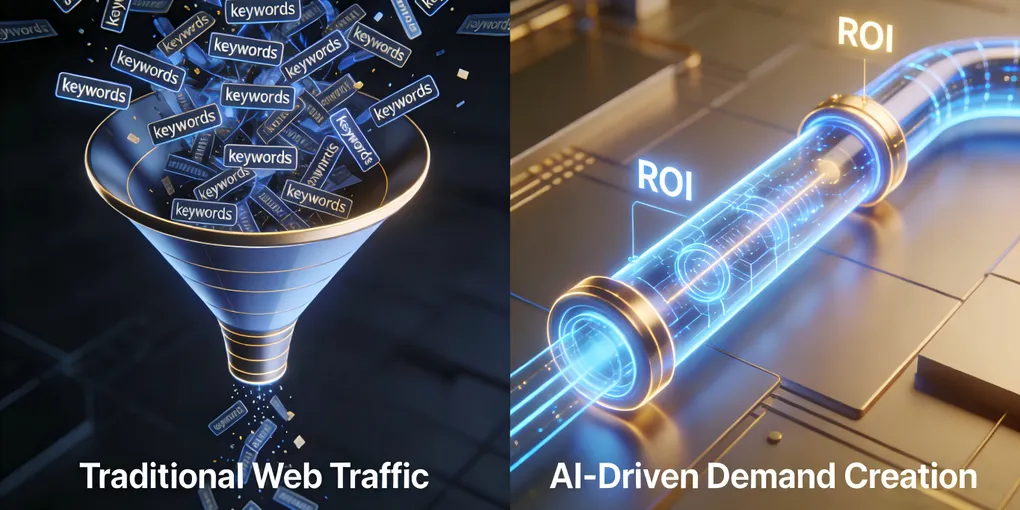
Stop Chasing Vanity Metrics! The 2026 Full-Funnel Marketing Blueprint for Sustainable Independent Site Growth
Hi everyone, this is Neo.
Lately I’ve been talking with a lot of owners and operators of independent sites (B2B and B2C alike), and there’s a shared anxiety: “Traffic is getting more expensive, SEO rankings don’t seem to work like they used to, we’re spending on PPC, leads are coming in — but the actual sales turning into real money are disappointing.”
Why is this happening? Because our marketing environment has changed dramatically. With the AI era, the way users discover brands has changed; at the same time, economic uncertainty has made buyers more cautious and lengthened their decision cycles.
If we still cling to the old mindsets — “traffic equals growth,” “lead count equals success” — we’ll easily fall into the vanity metrics trap. Today, drawing on the latest industry insights, I want to break down with you how to move from simply “getting traffic” to “driving growth” — and build a full-funnel blueprint across SEO, PPC, and KPIs.
1. From “Performance SEO” to “Demand SEO”: How AI Is Reshaping Search
In the past, SEO was about making sure users found you in a static list of results. We did keyword research, wrote content, built links — all to snag the user’s “click” at the moment they’d already decided what they needed.
But now, AI is upending that model. AI has moved “discovery” directly into “the answer itself.” Users no longer need to click through ten pages; AI hands them a synthesized answer and cites only a handful of brands in it.
On the surface that looks like lost traffic. But underneath, it’s a massive demand creation opportunity. When your brand is repeatedly mentioned and explained in AI-generated answers, you build “mental availability” in users’ minds. Before they even start comparing vendors, you’re already on their shortlist.
So modern SEO’s focus must shift from “optimizing individual pages” to “defining your brand entity.” AI cares more about who you are, what you do, where you serve, and what problems you solve.
Neo’s take: A lot of independent site sellers are still grinding away at rankings for specific head terms — in the AI era, that’s no longer enough. You need a consistent brand narrative across the entire web. AI relies on citations, consensus, and verifiable facts. Don’t try to show up in every topic; focus on the problems you actually solve, so AI can summarize your brand’s value in one clean sentence. Remember: AI recommends you because it sees you as a “reliable component,” not because you stacked keywords.
2. Lead Volume Is a Trap — Conversion Quality Is What Matters
When it comes to lead generation, many companies still believe “the more the merrier.” But in reality, if the marketing team generates demand faster than the operations team can fulfill it, the result isn’t growth — it’s friction.
For example, a B2B site gets flooded with low-quality inquiries; the sales team wastes time on unqualified prospects, response times slow down, and customer experience suffers.
In today’s environment, buyers take longer to decide and are more price-sensitive. They don’t want to be “sold to” — they want “certainty.” So marketing’s focus must shift from “capturing clicks” to “building trust.”
What should we be paying attention to?
- Visibility at intent moments: Instead of chasing broad industry head terms, focus on high-intent long-tail terms. Ranking for “industrial HVAC maintenance partner” may drive far less traffic than “HVAC system,” but conversion rates and sales efficiency will be far higher.
- Digital experience that lowers buyer risk: In longer purchase cycles, your website isn’t a brochure — it’s a “validation tool.” Clear positioning, proof of value, and a professional UX are key.
- Shared data analysis: Marketing knows where demand comes from; sales and operations know which demand is profitable. These two must be connected.
Neo’s take: Owners, stop evaluating your marketing team purely on “inquiry volume”! If the backend can’t digest the volume, or the leads aren’t qualified, a flood of MQLs (marketing qualified leads) will only drag down the sales team. The real growth metric is “qualified, actionable demand.” Require your marketing and sales teams to align on definitions. Give me 10 precise, high-intent prospects over 100 useless filler inquiries any day.
3. Digital PR + SEO: A Full-Funnel Content Strategy
Have you noticed that search rankings are getting harder to move recently? Google is leaning harder on E-E-A-T (Experience, Expertise, Authoritativeness, Trust).
The truth is, your audience may already know about your product or industry before they even search — from news sites, social media, podcasts, and other platforms. Digital PR is how you earn authoritative media mentions and backlinks at those audience touchpoints.
Take Lectric eBikes, a well-known American e-bike brand. How did they grow from under 40K monthly organic visits to 200K+?
- Awareness stage: They earned coverage on environmental and tech news platforms, emphasizing the eco benefits of their products and offering media the CEO’s expert insights and proprietary data.
- Consideration stage: They got mentioned in articles about market success and customer satisfaction (like price-comparison reviews against competitors), building trust.
- Decision stage: Their site offers clear product comparisons, reviews, and transparent pricing, precisely capturing search traffic on “brand terms” and “purchase-intent terms.”
Neo’s take: For global brands, link building can no longer be the old game of paying for cheap blog links. You need to combine digital PR with SEO. By publishing proprietary data reports and founder expert commentary, you attract organic coverage from mainstream overseas media or niche industry outlets. That doesn’t just earn high-quality backlinks and boost SEO authority — it genuinely influences audience purchase decisions.
4. PPC Account Structure: It Must Reflect Your Business Model
I’ve seen plenty of Google Ads accounts for independent sites that were built bottom-up: start with keyword research, then group by theme or match type.
What’s the result? When the boss asks, “How much did we spend on our B2B product line in Europe, and what’s the ROI?” the media buyer spends half a day stitching together Excel sheets — and the data is still a mess.
If your PPC structure doesn’t match your company’s business model, budget allocation becomes blind.
A better PPC account architecture starts from the top:
- Mirror business units or P&L: For example, split “consumer products,” “business wholesale,” and “accessories” into separate campaigns. Budget allocation and ROI calculation become instantly clear.
- Segment by funnel stage or intent: Separate brand terms (hot leads), high-intent non-brand terms, informational research terms, and competitor terms. Different intents call for different bid strategies and landing pages.
- Separate testing from scaling: Keep an “evergreen” campaign that steadily converts, and run a separate “test campaign” for new audiences or new creatives — so testing doesn’t undermine your base.
Neo’s take: Ad buying isn’t a pure arithmetic problem; it’s an extension of business strategy. If you outsource to an agency, make sure they understand your business model, margins, and sales cycle — not just CPC and CTR. Only when your PPC account structure aligns with how finance and sales look at the numbers can ad spend truly become an engine for business growth.
5. Where KPIs Should Ultimately Point: Real Business Outcomes
Finally, let’s talk about KPIs.
Digital marketing is full of metrics — CTR, conversion rate, ROAS, and so on. But you need to understand: SEO/PPC KPIs don’t equal the business’s final ROI.
If you drive site traffic up and form submissions increase, but the company still doesn’t make money (terrible lead quality, or conversion costs above gross margin), it’s still a failure in the owner’s eyes.
So we need to work backward from the “end goal.” Understand the company’s core business metrics (actual revenue, profit margins, customer lifetime value LTV, customer acquisition cost CAC), then map digital marketing touchpoints to those metrics.
Neo’s take: Marketers need to step out of their “traffic comfort zone” and learn a bit of finance and sales. Don’t show up to the review meeting smugly brandishing gorgeous traffic growth charts — dare to own the final “closed revenue.” When marketing and business teams speak the same language, marketing is seen as an “investment,” not a “cost.”
Summary
Marketing for overseas independent sites in 2026 and beyond is no longer a single-channel fight. It’s a systems engineering problem that needs a holistic view.
- Embrace demand SEO: In the AI era, build mental availability through a clear brand entity and web-wide consensus.
- Chase high-quality leads: Align with operations capacity — no fake prosperity, only real conversions.
- Integrate PR with SEO: Build authority and trust at every touchpoint of the audience journey.
- Rebuild your PPC structure: Make your ad account structure a direct mirror of your business model.
- Unify KPIs with ROI: Break down the silos and make marketing metrics truly serve business outcomes.
I hope this article gives you some fresh inspiration for running your independent site. If you have any questions, feel free to leave a comment below.