Google Search Traffic Is Plummeting: It's Time for Independent Site Sellers to Change Their SEO Strategy
Hi everyone, this is Neo.
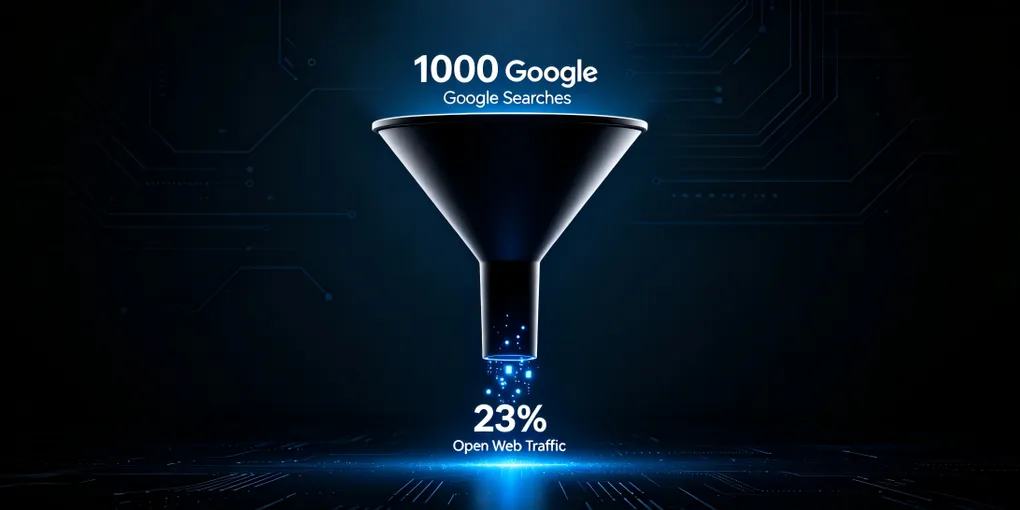
Recently the SEO world was rocked by a report — SparkToro released data showing that out of every 1,000 Google searches, only 232 click through to open websites. In other words, Google’s traffic to external sites has fallen to 23.2%.
For context: in 2024, that number was 36%. In a single year, the open web’s click share has plummeted nearly 13 percentage points. If you run an independent site, that number might take your breath away.
Today, let’s dissect this report — what exactly is happening with Google search, and how we independent site sellers should respond.
Part 1: 68% of searches produce no clicks at all
SparkToro founder Rand Fishkin analyzed Similarweb data from January to April and found US search behavior broadly splits into three categories:
- 39% of searches: users look at the results, do nothing, and leave.
- 29% of searches: users aren’t satisfied and re-type a new keyword.
- 32% of searches: users click a link.
In other words, 68% of searches produce zero clicks. Only 32% of searches actually flow to a webpage.
And of that 32%, only 66% goes to open websites; 27% goes to Google’s own products (YouTube, Maps, AI Mode), and 6% is taken by paid ads.
Doing the math: 1,000 searches × 32% × 66% = 211.2 clicks to open websites. SparkToro weights it to 232 because the data adjusts desktop and mobile ratios.
Neo’s take: The “zero-click search” share is shockingly high. We used to assume that once a keyword ranks, users will click in. But now users may get their answer right on the results page — especially since AI Overviews put the answer summary right at the top, giving users no reason to click into your site.
Part 2: AI Overviews are the “culprit”
Fishkin argues that the main driver of this click-rate crash is AI Overviews.
Ahrefs data backs this up: AI Overviews now appear in over 20% of search results, and when one appears, click-through drops by nearly 60%.
Think about it: users used to search “best running shoes for flat feet” and see 10 website links, maybe clicking into 3-4 to compare. Now Google generates an AI summary at the top listing everyone’s pros and cons. Users read the summary and they’re satisfied — why would they click into your site?
Another piece of evidence comes from Ahrefs’ traffic tracker: from June 2025 to May 2026, Google’s traffic share to external sites fell 8 percentage points.
Neo’s take: AI Overviews hit informational queries hardest. For “how to,” “what is,” and “best” type keywords, users want an answer, and AI Overview delivers it directly — the website becomes the “exploited” party. But here’s the key point — where does AI Overview content come from? It still scrapes websites. So the higher your content quality, the more likely you are to be cited by AI Overview — but users may not click in. It’s an awkward position of “cited but not profited.”
Part 3: Paid ads’ share is quietly rising
The report also flags a noteworthy number: paid clicks grew from 1% in 2024 to 6% in 2026.
But Fishkin cautions against over-reading this increase. He says the 2024 data source (Datos) had a high share of users with ad blockers installed, hiding search ads. So the real paid share in 2024 may have been higher than 1%, and while 2026’s 6% is up, the growth may not be as dramatic as it looks on the surface.
Either way, paid ads’ share is definitely rising. Google’s monetization pressure keeps growing, and ad slots will only multiply.
Neo’s take: For independent site sellers, this means two things. First, SEO’s “free traffic” is getting more crowded and organic clicks are shrinking. Second, Google’s commercialization trend is irreversible — paid ad competition will only intensify. If your independent site still relies purely on SEO, it’s really time to consider an “SEO + SEM” combination. Especially for B2C independent sites — if your Google Ads ROI is still positive, don’t hesitate to add budget when you can.
Part 4: Google’s response doesn’t hold up
Facing this data, Google’s response is interesting.
Google’s VP of Search, Liz Reid, says total organic click volume is “relatively stable” and that AI Overviews merely removed “bounce clicks” — the clicks where users came in, grabbed a fact, and left. The implication: AI Overviews removed “low-quality clicks” that sites won’t miss.
The problem: Google has never published data supporting this claim.
SparkToro measures click rate per search, while Reid talks about total click volume. These aren’t the same metric. If total search volume grows, total clicks could stay flat or even rise even as per-search click rate falls. But per-search click rate is falling — that’s a fact, and only Google itself knows what total clicks are actually doing.
Neo’s take: Google’s framing is essentially sleight of hand. For independent sites, what matters isn’t “did total clicks rise” but “can my site get traffic from Google.” If per-search click rate is dropping, it means your competitors — including Google’s own products — are eating your share. More ironically, Google says AI Overviews removed “bounce clicks,” but your site gets cited by AI Overviews while users don’t click in — isn’t that another form of “being exploited for free”?
Part 5: Is SEO still useful? What is it useful for?
Fishkin wrote a fascinating line in the report: “SEO matters as much as ever, it just won’t earn you traffic the way it once did.”
SEO still matters, but the way it earns you money has changed.
He cites Cyrus Shepard’s analysis, noting these types of searches still benefit from SEO:
- Branded searches: users directly search your brand name — AI Overview can’t easily replace this.
- Local businesses: Google Maps and local pack results still need business pages.
- High-intent transactional queries: like “buy iPhone 16 Pro Max” — users have clear purchase intent and typically click into e-commerce sites.
Neo’s take: I fully agree with this assessment. For independent site sellers, SEO strategy needs adjusting:
- Informational content’s value is declining because AI Overview directly eats that traffic. But you still need it, because AI Overview sources its content from websites — the higher your content quality, the more likely you’ll be cited, which is a form of “brand exposure.”
- Transactional content and branded keywords are the future focus. Users searching “best coffee maker” may not click your site, but when they search “yourbrand coffee maker review” or “buy yourbrand coffee maker,” you still need to rank #1.
- Long-tail keywords and vertical niches still have opportunity. AI Overview currently covers high-volume, information-dense keywords; for highly specialized, niche searches, its coverage isn’t there yet.
Part 6: AI Mode is the next variable
The report also flags a trend worth watching: AI Mode.
AI Mode currently accounts for only 0.34% of searches, but Google says it has over 1 billion monthly active users and query volume doubling every quarter.
AI Mode differs from AI Overview — it’s a deeper, conversational search experience. If users shift from “searching keywords” to “asking AI,” traditional SEO logic gets further disrupted.
Neo’s take: AI Mode’s rise means users’ information acquisition is shifting from “browsing lists” to “conversational retrieval.” For independent sites, this is both a challenge and an opportunity. The challenge: traditional ranking logic may no longer apply. The opportunity: if your product information gets accurately cited and recommended by AI Mode, you could gain a brand-new traffic entry point. Start paying attention to AI Mode optimization now (structured data, product feed quality) — positioning ahead of competitors could pay dividends later.
Summary
The report’s core message boils down to three points:
- Google’s traffic to open websites is shrinking fast — from 36% in 2024 to 23% in 2026.
- AI Overviews are the main driver — informational keyword click-through has crashed nearly 60%.
- SEO still has value, but strategy must adjust — branded keywords, local search, and high-intent transactional keywords are the future focus; pure informational content’s direct traffic value is declining.
For independent site sellers, this means:
- Stop treating SEO as your only traffic source; diversify (social media, email, influencers, paid ads) — it’s mandatory.
- Re-examine your keyword strategy; concentrate resources on branded and transactional keywords.
- Watch AI Mode’s development; set up structured data and product information optimization early.
Google search’s “golden age” may be over, but the opportunity for independent sites isn’t. Adapting beats complaining.