Google's AI Search Shake-Up: The Path to Your Site Just Got Longer — How Should Sellers Respond?
Hi everyone, this is Neo.
It’s been a turbulent week in the overseas SEO community — Google is quietly rewriting the rules again. From AI Mode increasingly routing traffic to itself, to fully intelligent map search, to deep parsing of audio and video, every move Google makes is lengthening the path from “search” to “clicking into your independent site.”
Today, let’s run through the week’s key Google Search developments and how B2B and B2C sellers going global should respond.
1. Google’s AI Mode Is Getting “Biased”: Feeding Traffic to Itself
According to the third AI Mode citation report from SE Ranking, Google is increasingly citing its own properties in AI-generated answers.
The key facts: In just the past 9 months, the share of links pointing to Google’s own properties in AI answers jumped from 7% to 21% — a threefold increase! These internal links used to go mostly to Google Business Profiles, but now more and more point directly to Google’s own organic results pages. In other words, 17% of citation links are Google “buying from itself” — far ahead of any external source.
Neo’s take: See the pattern? Google’s strategy is obvious: keep users inside its own walled garden as much as possible. What does that mean for independent site sellers? It means AI may give the answer, but the clicks (external links) flowing to your site will likely keep shrinking. The old mindset of “rank #1 on Google and traffic follows” needs to go. We should focus more on becoming the “information source” behind AI answers (unique data, deep industry insights), not just stacking keywords.
2. Google Maps Launches Ask Maps: A New AI Opportunity for Local Businesses
Google Maps just rolled out “Ask Maps,” a conversational AI feature (powered by Gemini). Users can now ask the map questions in natural language and get place recommendations right on the map.
The key facts: Ask Maps’ answers draw on Google’s vast database of places and reviews, and personalize recommendations based on a user’s search history and saved places. It’s currently live in the US and India.
Neo’s take: For B2B/B2C sellers with overseas showrooms, warehouse pickup points, or physical stores, this is huge! Before, searching a map gave you a row of cold pins. Now AI will actively “recommend” your store to users. That means meticulous Google Business Profile management is non-negotiable — especially high-quality customer reviews, which will become the core basis for AI recommending you.
3. Google Can Now Really “Understand” Audio and Video: The Multimodal Search Era Arrives
In a recent interview, Google’s search chief Liz Reid dropped a bombshell: AI is fundamentally changing how Google indexes content.
The key facts: Google’s multimodal AI models (Multimodal LLMs) are no longer limited to reading video captions or titles. They can directly “hear” audio and “understand” the actual substance of video — including style, depth, and meaning. On top of that, for publishers with paywalls, Google will even surface paywalled content more prominently to users who are already subscribers.
Neo’s take: This is a massive signal! In the past, video marketing for your independent site (e.g., repurposing YouTube/TikTok content) leaned on well-written titles and descriptions. Not anymore — Google can directly understand what a video is actually about. That means high-quality, substantive original audio and video content is about to enjoy a huge traffic dividend. B2B sellers should shoot more factory walkthroughs and deep product review videos; B2C sellers need to focus on authenticity and engagement. And stop trying to fool Google with clickbait titles.
4. Search Console’s Branded Queries Filter Is Now Fully Rolled Out
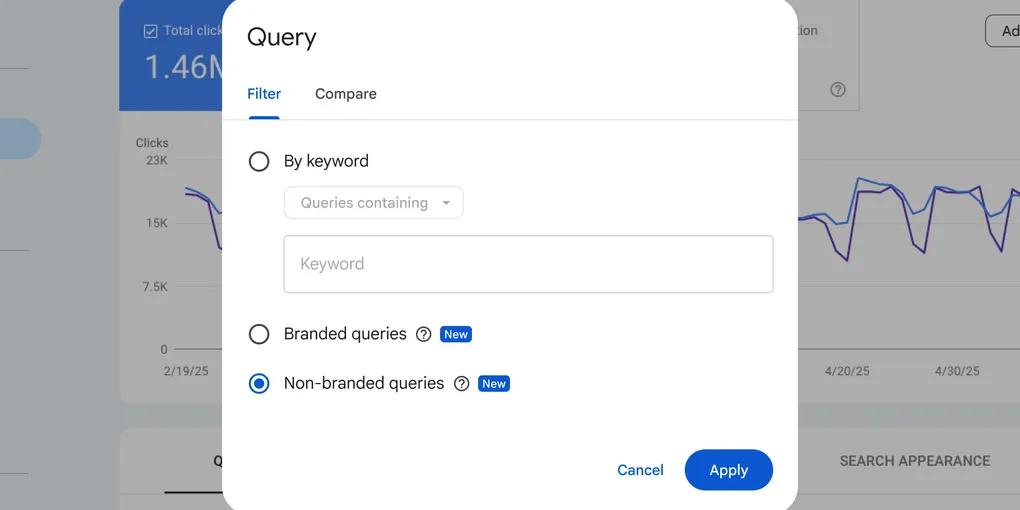
Finally, some good news on the SEO tools front. Google Search Console’s branded queries filter is now available to all eligible sites.
The key facts: The feature uses AI to automatically split your site’s search terms into “branded” and “non-branded” — even recognizing misspellings and searches containing only product names. You can’t customize which terms count as branded yet, but it already massively simplifies our analysis work.
Neo’s take: This feature is a godsend for site operators and SEOs! Previously we had to write complex regex to strip out brand terms. Now AI sorts it for you. That means owners and marketing leads can finally see clearly how much genuinely “new customer traffic” (non-branded) the SEO team is driving — instead of taking credit for old customers typing your brand name. Data is more transparent, and strategy gets sharper.
Summary: The Distance Is Growing, but Content Is Still King
Taken together, this week’s developments tell one clear story: the path from user search to your website is getting longer.
AI Overviews are intercepting traffic, Maps is inserting an AI layer, and Google is even evaluating content more deeply before deciding to surface it. Every step adds to the AI’s power.
Facing this trend, independent site sellers have one option: keep delivering irreplaceable “Golden Knowledge” — unique data, deep industry insights, and authentic audio/video content — to keep earning a slice of the AI-era pie.
References: