MOFU Keywords: The Secret Weapon That Connects Traffic to Orders
As an independent site operator, have you ever hit this wall: SEO and ads bring in plenty of traffic, but inquiries and orders stay few and far between? Visitors come and go, as if they’ve fallen into a “traffic black hole” that never lets them settle.
If that sounds familiar, the problem probably lives in your marketing funnel.
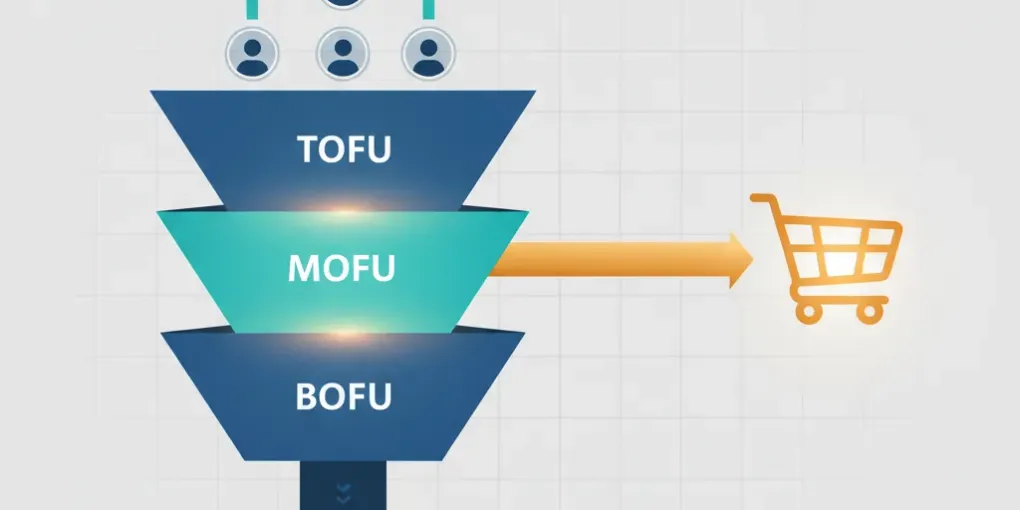
We usually divide the buying journey into three stages: TOFU (Top of Funnel), MOFU (Middle of Funnel), and BOFU (Bottom of Funnel).
- TOFU casts a wide net, attracting potential users who just realized they have a problem and are looking for information.
- BOFU lands the final blow, converting users who already know what they want and are ready to buy.
- And MOFU — the middle link that bridges both ends — is exactly the stage most independent sites overlook, and yet it’s the most crucial. It connects vague awareness to clear purchase intent: the golden zone for building trust, qualifying prospects, and ultimately driving conversions.
Today, let’s take a deep dive into the world of MOFU and talk about how to use MOFU keywords to build a solid bridge from traffic to orders for your independent site.
I. What Exactly Are MOFU Keywords?
Put simply, MOFU keywords are the search terms users type during the “evaluation and comparison” stage. They’ve already clearly identified their problem and are actively looking for and comparing different solutions.
Let’s make it more tangible with a table showing how B2C and B2B users search differently at each funnel stage.
| Funnel Stage | B2C Scenario (wireless earbuds) | B2B Scenario (industrial laser cutting machines) |
|---|---|---|
| TOFU (Awareness) | “how to improve focus while working from home” | “manufacturing efficiency guide” |
| MOFU (Consideration) | “best noise cancelling earbuds 2024” / “Sony vs Bose earbuds” | “laser cutting machine for metal” / “best industrial laser cutter brands” |
| BOFU (Decision) | “Sony WF-1000XM5 discount” | “Bystronic laser cutter price” / “get a quote for fiber laser machine” |
See that? When users enter the MOFU stage, their search intent becomes much clearer. They’re no longer browsing for general information — they’re doing their “homework,” gathering evidence for the final purchase decision.
II. Why Independent Sites Must Care About MOFU Keywords
With traffic costs climbing every day, capturing users in the MOFU stage means capturing high-quality prospects. It’s not just about conversion — it’s about building your brand’s moat.
-
Get higher-quality leads TOFU traffic is broad but fuzzy in intent and converts poorly. MOFU users, by contrast, have already educated themselves — they know what they need and are only deciding “who will provide it.” That kind of traffic is undeniably one step closer to “buying,” with enormous conversion potential.
-
Get ahead of the competition Many competitors pour all their energy into fighting over BOFU keywords — brand terms, price terms. That “red ocean” is brutally competitive. By planting MOFU content, you can “intercept” users before they make a brand decision, planting a seed of expertise in their minds and becoming their first choice during evaluation.
-
Bridge the gap between traffic and revenue TOFU content drives traffic, BOFU content monetizes, and MOFU content is the perfect bridge. It catches the broad traffic TOFU brings in, filters and nurtures it with in-depth content, and smoothly guides it to BOFU conversion pages — maximizing the value of every drop of traffic.
-
Lower advertising costs (PPC) In paid search, BOFU keywords usually have the highest CPC (cost per click) because everyone wants to fight over those “lambs ready for slaughter.” MOFU keywords, by comparison, face less competition and carry more reasonable CPCs. Getting highly interested users at lower cost? Why not?
-
Build your site’s expertise and authority (topical authority) A site that only sells products comes across as purely “money-chasing.” A site that offers deep comparisons, solutions, and industry guides demonstrates expertise and authority. Google’s E-E-A-T (Experience, Expertise, Authoritativeness, Trustworthiness) principles essentially encourage sites to become experts in their fields. MOFU content is the ideal vehicle for showing off professional knowledge, building trust, and attracting high-quality backlinks.
III. How to Pinpoint High-Value MOFU Keywords
The key to identifying MOFU keywords is understanding the “evaluation” intent behind them. These keywords typically include certain “modifier” words.
Here are the common types of MOFU keywords — you can apply them directly to your industry:
-
Comparison: users are torn between two or more options.
- Modifiers: vs, versus, compare, alternative, “X or Y which is better”
- Examples:
Shopify vs WooCommerce,iPhone vs Samsung camera
-
Best-of: users are looking for the best option in a particular category.
- Modifiers: best, top, review, guide, “recommended,” “rankings”
- Examples:
best email marketing tools,top hiking backpacks for travel
-
Feature-driven: users know they need a specific feature.
- Modifiers: with, for, “with… feature,” “supports…”
- Examples:
CRM with WhatsApp integration,vacuum cleaner with HEPA filter
-
Industry/scenario-specific: users are looking for solutions for a specific industry or scenario.
- Modifiers: for, “for…”
- Examples:
accounting software for freelancers,scheduling software for local businesses
-
Pain-solution: users are looking for ways to solve a specific pain point.
- Modifiers: how to, reduce, fix, solve, “how to solve,” “how to fix”
- Examples:
how to reduce churn in SaaS,how to remove pet hair from carpet
Don’t be scared off by keywords with seemingly low search volume. In B2B, one high-intent MOFU long-tail term can be worth more than hundreds of vague TOFU visitors.
IV. How to Create High-Converting MOFU Content
Once you’ve found the keywords, the next step is creating content that moves users and outshines competitors. The core art of MOFU content: deliver value first, sell gently second.
-
Match search intent precisely This is the most basic and most important point. Users searching “best coffee grinders under $100” want a clear list with prices, pros and cons, and reasons for the recommendation — not an essay on the history of the coffee grinder. The content format must serve the user’s intent.
-
Use highly structured content Users in the evaluation stage are busy — they’ll have multiple pages open for comparison. Your content must be scannable so they can grab key information fast.
- Comparison tables: show specs of different products/solutions at a glance.
- Pros & cons lists: clearly lay out the upsides and downsides of each option.
- FAQ sections: pre-answer the doubts users might have and put their concerns to rest.
-
Build strong trust signals (E-E-A-T) In an era flooded with AI-generated content, trust is more precious than ever.
- Show real case studies: real user stories and data are the most persuasive.
- Transparent review process: if it’s a “best-of” list, openly show your review criteria and process.
- Author info and credentials: let users know the article was written by a genuine industry expert.
- Customer reviews and certifications: cite customer praise and show industry certifications (like CE, FCC) — these are hard currency.
- Link authoritative sources: when citing data or facts, link to authoritative research or official documentation.
-
Deploy a smart internal linking strategy MOFU pages are the hubs of your site’s internal linking.
- Link up (TOFU): for basic concepts mentioned in the article, link to your TOFU educational posts to serve users at different awareness stages.
- Link down (BOFU): at natural points, gently guide users to your product pages, pricing pages, or contact pages.
- Link across (MOFU): link to other related MOFU pages — say, from a “best coffee machine” article to a “how to choose coffee beans” guide — building a content topic hub that boosts your site’s authority.
-
Design “softer” calls to action (CTAs) MOFU users aren’t ready to “buy now.” A hard “Buy Now” will only scare them off. You need “soft,” low-risk CTAs that make them willing to build a deeper connection with you.
- Common B2B CTAs: “download the industry whitepaper,” “book a free 15-minute consultation,” “request a product demo”
- Common B2C CTAs: “get the buying guide PDF,” “sign up to receive new product discounts,” “take a fun quiz”
V. How to Measure MOFU Performance
Measuring MOFU content isn’t like BOFU, where you look straight at order numbers. MOFU value shows up more in “influence.”
- Watch assisted conversions: in Google Analytics 4, check the “conversion paths” report. You’ll find that many users who eventually bought visited your MOFU pages along their conversion path. These pages are the “assists” — their value can’t be ignored.
- Track keyword rankings: use tools like Semrush or Ahrefs to monitor whether your core MOFU keywords are steadily climbing.
- Analyze user engagement: compared to your TOFU content, MOFU content should show higher “time on page” and “scroll depth,” and lower “bounce rate.” That indicates users are genuinely reading and researching your content.
Conclusion
SEO for an independent site is a long war. If TOFU is clearing new territory and BOFU is harvesting the crops, then MOFU is the deep cultivation that enriches the soil.
It requires you to genuinely stand in your users’ shoes and think about what problems they’ll face and what help they need. When you sincerely provide value and become their “advisor” and “trusted friend” in the decision process, trust comes naturally — and orders follow as a matter of course.
Starting today, review your content strategy, find the forgotten MOFU gap, and start planning your first in-depth MOFU piece. That investment will pay you back with generous returns down the road.
Reference links: