The Next Big Wave for Independent Sites: From SEO to AAIO — Is Your Website Ready for AI Agents?
Hi everyone, this is Neo.
After years of building overseas independent sites, we’ve gotten used to studying SEO (search engine optimization) and CRO (conversion rate optimization) strategies. For the past 25 years, the default assumption behind every website we built was: websites are for humans. We obsessed over font sizes, button colors, and interaction flows so that human users would click, scroll, and browse more easily.
But today I’m here to tell you: that era is ending. The internet is going through the biggest transformation since it was born. Right now, your independent site has two completely different audiences: humans and AI agents.
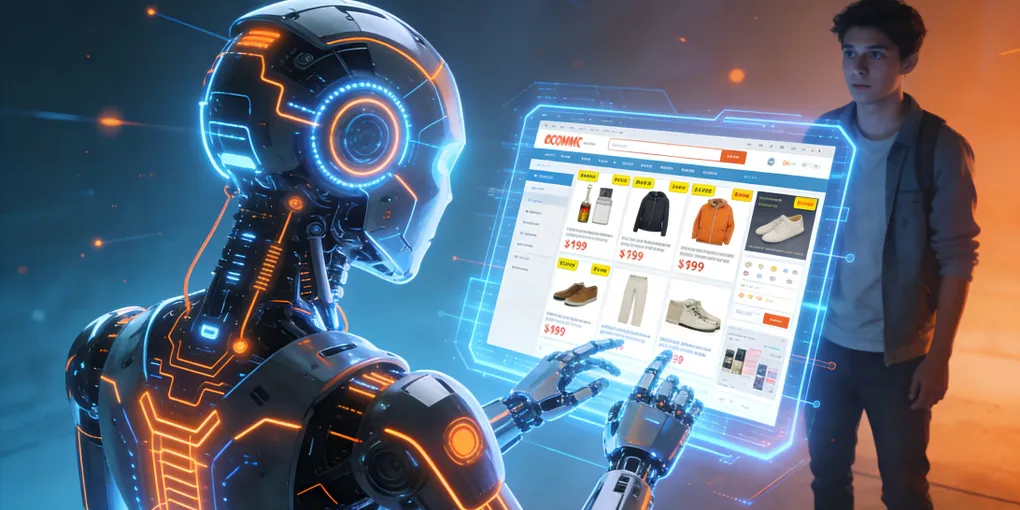
These AI agents are already shopping online for people, doing B2B procurement research, booking services, and making decisions. The core question we’re digging into today: can AI actually use your website smoothly?
The Alphabet Soup of Optimization: From SEO to AEO, GEO, and AAIO
Let’s look back at how traffic acquisition has evolved over the past few decades:
- SEO (Search Engine Optimization): The undisputed king from the mid-90s through the 2010s. Simple goal: rank higher on Google. We optimized keywords (like
b2b wholesale supplier), built backlinks, and tidied up site structure so crawlers could index us. Success meant showing up on page one when customers searched. - AEO (Answer Engine Optimization): As AI started answering questions directly, Google introduced Featured Snippets and AI Overviews. Ranking high wasn’t enough anymore — you had to become the “cited source” in AI-generated answers.
- GEO (Generative Engine Optimization): Then came ChatGPT, Claude, and Perplexity, which don’t just cite — they synthesize multiple sources into polished answers. GEO ensures your content and expertise get woven into AI’s final responses.
- AAIO (Agentic AI Optimization): The newest evolution, and a genuine paradigm shift! AAIO isn’t just about being “found” or “cited” — it’s about being used by AI agents. AI will take action autonomously on behalf of humans (auto price-comparing, auto add-to-cart, auto-submitting inquiries).
Neo’s take: Plenty of B2B owners and B2C operators are still grinding away at traditional SEO backlinks, but the traffic gateway is being hijacked by AI. When a consumer just tells their phone “buy me the best-reviewed black waterproof rain jacket,” or your B2B buyer has an AI collect and compare quotes and credentials from five suppliers, classic SEO rankings stop meaning anything. What we need to think about is how to make AI “like” and “understand” our sites.
December 2025: AI’s “HTML Moment”
Why is AAIO suddenly so important? Because the infrastructure is already built.
On December 9, 2025, the Linux Foundation announced the Agentic AI Foundation (AAIF). Who are its eight platinum members? AWS, Anthropic, Block, Bloomberg, Cloudflare, Google, Microsoft, and OpenAI.
Notice that: these companies, which fight like titans everywhere else, chose shared standards over going it alone when it comes to AI agent infrastructure. That’s a loud signal — AI agents are the foundational layer of the future.
They contributed three core projects:
- MCP (Model Context Protocol): Anthropic’s universal standard for connecting AI systems to tools and data sources.
- AGENTS.md: OpenAI’s standardized spec for guiding how AI agents should act inside codebases and websites.
- goose: Block’s open-source, local-first agent framework.
Neo’s take: This is like the W3C setting HTML and CSS standards after the browser wars of the 90s. Once AI has unified protocols (like MCP and NLWeb), agents from different companies can access our independent sites in a standardized way. If you missed HTML in the PC era and missed apps in the mobile era, do not miss the AI agent protocols now.
The Three Levers for Capturing AI Traffic: Discovery, Citation, Action
In the AAIO era, you need to optimize on three levels:
1. Discovery
Can AI systems find your website? AI crawlers like GPTBot, ClaudeBot, and PerplexityBot are indexing the entire web. If you’ve blocked them in robots.txt, or your site architecture makes them impossible to parse, you’re “invisible” in the AI era. Discovery is the foundation — if AI can’t find you, nothing else matters.
2. Citation
When AI generates an answer, who does it choose to cite? Your content needs authority, accuracy, and relevance. Think clear structured data (Schema Markup), clean information hierarchies, and demonstrated real expertise (E-E-A-T).
3. Action
This is what sets AAIO apart from every optimization that came before! When an AI agent lands on your independent site, it may need to click buttons, fill forms, browse menus, compare B2B product specs, or even complete a purchase. If your site crashes or throws errors when AI tries to interact with it, you’re handing orders straight to your competitors.
Neo’s take: Before, CRO meant studying heatmaps to see where humans got stuck. Now we need AXO (Agent Experience Optimization) — testing whether AI can smoothly walk the “add to cart → checkout” or “submit an inquiry” journey on your site. Make sure your site has clean, semantic HTML and an API-friendly architecture.
Why You Need to Act Now
Two trends in 2026 are forcing us to change immediately:
-
Agentic browsers are going mainstream:
- Perplexity’s Comet combines search with a full browser.
- OpenAI’s ChatGPT Atlas includes an agent mode that autonomously completes multi-step tasks.
- Chrome’s automated browsing (powered by Gemini) is rolling out to hundreds of millions of users. Chrome has 3 billion users! When the world’s most popular browser can scroll, click, type, and navigate on its own, sites that don’t support AI agents will be eliminated outright.
-
The payment rails of e-commerce are being rebuilt: Stripe, Shopify, and OpenAI are building the infrastructure for AI agents to complete purchases (the Agentic Commerce Protocol). Checkout stops being a web page and becomes an API endpoint. AI can research, select, and buy on behalf of users — without the user ever opening your site.
Neo’s take: B2C sellers should pay special attention to new standards like Shopify’s Universal Commerce Protocol (UCP) — tomorrow’s impulse purchases may not be clicked by humans at all, but auto-ordered by AI based on the owner’s preferences. B2B sellers should make sure your product catalogs and spec tables can be extracted cleanly by AI, because buyers’ AI assistants hate messy PDFs and unscrapeable Flash charts.
Summary
Traditional SEO asks: “How do I rank high on Google?” AAIO asks: “How do I become the standard answer? How do I let AI complete inquiries or transactions on my site — smoothly, with no human involved?”
The era of AI agents is here. Don’t treat this as a minor SEO tweak — it’s a fundamental shift in your site’s underlying architecture. For cross-border independent sites, embracing AAIO early is how you get your ticket to the next decade.