
Arm Your Independent Site with Structured Data — Your Secret Weapon
Hi everyone, this is Neo.
Lately I’ve been talking to a lot of independent site owners, and there’s one anxiety almost everyone shares:
With ChatGPT and Google’s AI Overviews flooding the scene, are users going to stop clicking into our sites altogether? They just ask the AI, get the answer, and leave. Is our SEO traffic doomed?
It feels like the traffic gateway changed overnight — from a familiar, optimizable channel into a completely opaque “black box.”
I totally understand that anxiety. But today I want to tell you: don’t panic! The opportunity is hiding right inside the change. And the secret weapon for seizing it might be something you’ve heard of but never taken seriously — structured data.
Today, in plain language and drawing on my hands-on experience, I’m going to walk you through the whole thing: how AI is actually affecting our traffic, and why structured data can become our “superpower” in the AI era.
Let’s Start with the “Known” Benefits: What Structured Data Can Do for You Right Now
Before we talk about some hazy future, let’s look at the concrete benefits you can see immediately after implementing today.
What is structured data?
Think of it as a standard format we proactively “feed” to search engines like Google and Bing. The content on our site — a blog post, a product — is obvious to humans, but for machines it needs “translation.” Structured data is that “translator.” It uses a language machines can instantly understand (like Schema.org) to tell the search engine clearly: “Hey, on this page there’s something called a ‘multi-function power drill,’ it costs $99, there are 800 in stock, and it has 56 five-star reviews.”
Doing this “translation” work brings two immediate benefits:
1. Higher Click-Through Rates: Make Your Search Result “Pop”
Once Google understands your page content, it may give you special treatment — rich results. Your search result is no longer a plain couple of lines of text; it can carry prices, ratings, FAQ dropdowns, video thumbnails, and more.
For example, say you sell industrial CNC machines. Without structured data, your Google result might be just a blue title line plus two lines of black description. But with Product and Review structured data, your result could show directly:
- Price range: $50,000 - $150,000
- Rating: ★★★★★ (18 reviews)
- Availability: In Stock
On a results page full of plain text, doesn’t your result with images and ratings stand out like a crane among chickens? How could the CTR not climb? The reference article mentions an appliance brand that tripled its product page CTR after doing this! That’s the most direct, real money on the table.
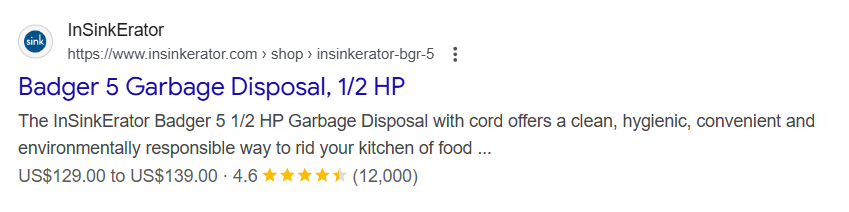 Image source: Search Engine Journal
2. More Non-Brand Traffic: Build Your Own “Brand Knowledge Graph”
The second benefit is more advanced — and more imaginative. Structured data doesn’t just describe “things” on a page; it can define the “relationships” between them.
That sounds abstract, so let’s use a B2B example. Say your company is called “Apex Machinery” and you sell a star product called the “Model-X Laser Cutter.”
With structured data, you can tell Google:
- The “Model-X Laser Cutter” is manufactured by (manufacturer) “Apex Machinery.”
- It is suitable for (isSuitableFor) two application areas: “metal cutting” and “wood engraving.”
- Its frequently asked questions (FAQ) include “What’s the maximum cutting thickness?” and “What’s the maintenance interval?”
When you “connect” all your products, company info, industry applications, and technical articles this way, you’re essentially building a “mini knowledge graph” of your brand inside Google’s “brain.”
The benefit: when a potential customer searches a very broad keyword that doesn’t include your brand — like best laser cutter for woodcraft — because Google already deeply understands your product specs and application areas through your knowledge graph, it’s much more likely to recommend your “Model-X” to that user.
This is the upgrade from “keyword optimization” to “entity optimization.” You’re no longer just competing for a word; you’re proving to Google that you are the expert entity in this field.
Now the “Unknown” Future: Why Structured Data Is Your Ticket to the AI Era
OK, we’ve covered the immediate benefits. Let’s go back to that anxious question from the start: is AI going to “swallow” all the traffic?
The answer: AI will reshape traffic, not swallow it. And structured data is the ticket that gets us on board the “starship Future.”
What Does AI’s “Black Box” Actually Need?
We think of AI as a black box because we don’t know what information it references when generating answers. But think about it: AI large language models (LLMs) don’t actually “understand” the world — their knowledge comes from the massive data they’ve learned. That creates a fatal problem: AI confidently spouts nonsense (hallucinations).
To solve this, the dominant technique today is called “retrieval-augmented generation” (RAG). In simple terms, before answering, AI searches its “library” (like the whole internet) the way a human would, finds the most relevant materials, and organizes its answer based on those “reliable” sources — instead of making things up.
Now the key question: in AI’s eyes, what kind of material counts as “reliable”?
You can probably guess: information that’s clearly structured, machine-readable, and from reputable sources.
That’s exactly where structured data shines!
Microsoft and Google are practically wearing “please use structured data” on their foreheads. Why? Because it helps their AI systems boost efficiency and cut costs dramatically — and most importantly, it reduces the odds of AI hallucinating. A product page marked up with Schema is like a “standard answer” with the key points already highlighted and the tables filled in — fast and accurate to cite.
We can’t yet precisely measure “how many times my product got cited by ChatGPT,” but one thing is certain: making your site content “AI-friendly” is the core SEO trend of the next 10 years. And doing structured data well is the first — and most important — step toward being AI-friendly.
From “Page SEO” to “Enterprise Knowledge Graph”
The reference article makes a very important point: the future competition is no longer about optimizing individual pages, but about building your entire enterprise knowledge graph.
The way users ask questions has changed in the AI era. They won’t just search “Model-X Laser Cutter”; they might ask: “Recommend a wood laser cutter that suits a small-to-medium studio, has low maintenance costs, and comes with after-sales service in California.”
To answer that, AI may need to query multiple information sources at once: your product pages, support pages, company intro, user reviews. If your site’s internal information is linked into a clear “knowledge network” through structured data, AI can easily find every answer within your “network” and deliver a perfect recommendation.
Conversely, if your information is isolated and messy, AI might glance at it and move on — recommending your competitor who did structured data properly.
Summary: What Should Independent Site Sellers Do?
Enough talk — here are some practical, actionable recommendations:
-
Stop ignoring it: Elevate structured data to the strategic level of your marketing. It’s not an optional technical nicety; it’s fundamental to whether you’ll keep earning organic traffic in the future.
-
Start with the basics: Don’t chase perfection in one step. Start with your most important pages. For B2C sites, at minimum nail these three Schema types: Product, Review, and FAQPage. For B2B sites, Product, Organization, Article, and FAQ are the foundation.
-
Use tools: You don’t need to hand-write code. Plenty of Shopify apps or WordPress plugins generate it automatically. And always use Google’s official “Rich Results Test” to check whether your generated code is valid.
-
Shift your mindset: Move from optimizing “keywords” to optimizing “entities” and “relationships.” Ask yourself: what is my core product? What are its features? What’s its relationship to my company, my customers, my industry? Then try expressing those relationships with structured data.
The AI search era has begun. The wild-west days of stacking keywords and backlinks to earn traffic are fading. The future belongs to brands that deliver clear, credible, high-quality information to both machines and humans.
And structured data is the first — and most important — business card we hand to the AI world.
References: