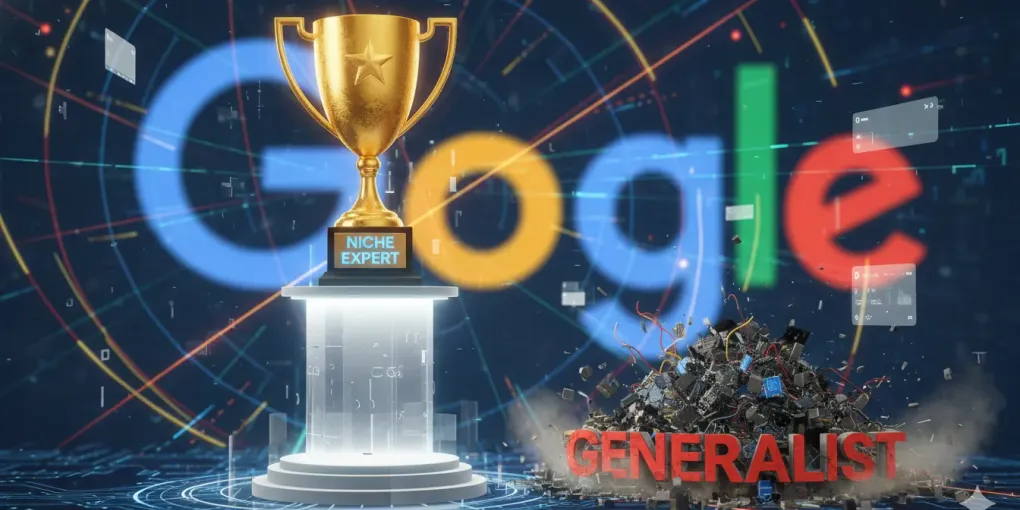
Google's December Core Update Recap: Why Vertical Sites Are Crushing General Stores
Hi everyone, this is Neo.
Lately, the whole niche site community has been talking about traffic fluctuations. Especially Google’s December Core Update, which has sent a lot of sellers’ moods on a roller-coaster ride.
Entering 2026, the rules of the SEO game are changing drastically. The old “mass-listing” playbook and “general store” approach seem to be failing more and more. This week, on top of Google’s algorithm update, the accuracy debate around AI-generated content (AIO) has also been raging — even Microsoft and Google executives got dragged into a public spat.
Today, I’m going to deep-dive this week’s big SEO events and what they really mean for those of us running overseas niche sites (especially B2B and B2C).
1. The Victory of Vertical Sites: Google Doesn’t Love “General Stores” Anymore
Based on early data from Google’s December core update, one trend is unmistakable: Google is now heavily favoring “expert” sites while snubbing “generalist” sites.
In simple terms, if your site sells everything — pet supplies to electronics, the whole nine yards — but doesn’t go deep in any category, you may have gotten hurt by this update. Conversely, sites focused on one narrow niche — say, “plus-size women’s clothing” or “outdoor camping lights” — saw noticeable ranking and traffic gains.
The data: Well-known SEO expert Aleyda Solís found that for high-conversion-intent queries like “Best of…”, vertical sites are taking over territory that used to belong to big comprehensive review sites.
Neo’s take:
Folks, the era of “small and beautiful” is really here.
Google’s logic now: if you know a little about everything, you’re probably an expert at nothing. For us niche site owners, this means product selection and positioning must be far more focused.
Don’t try to be an Amazon — you can’t out-Amazon Amazon. Instead, become an irreplaceable expert in one niche. If you’re B2B machinery, go deep on all the knowledge and pain points of that machinery category. If you’re B2C beauty, focus on one skin type or style.
Remember: depth > breadth. Authority no longer depends just on domain age — it’s about your expertise in a specific field.
2. AI Overviews (AIO) Fumbling: Be Extra Careful with Health Content
The Guardian recently broke a big story. Their investigation found that Google’s AI Overviews often spout nonsense when answering health and medical questions.
For example, ask the same health question and refresh a few times — the AI’s advice actually changes, even citing completely different sources. That has medical institutions and experts seriously worried. Google defends it as “incomplete screenshots” and claims most results are good, but it exposes a core problem: the trust crisis of AI.
Neo’s take:
What does this mean for us? If your niche site touches YMYL (Your Money Your Life) areas — supplements, medical devices, baby products — you must be more careful than ever.
Users are increasingly wary of AI-generated content (AI slop). If your site reads like a pile of AI-hallucinated drivel, users will bounce in a second, and Google will demote you.
How to fight back?
- Show the humans: Put real team photos and founder stories on your About Us page.
- Cite authority: Reference data from authoritative institutions in your articles, even get professionals to endorse you.
- No pure AI output: AI can assist, but always do a final human polish to ensure accuracy and warmth.
3. Big Tech Arrogance vs. User Backlash: Don’t Produce “AI Garbage”
There was also an interesting side story this week. Faced with complaints about AI content quality (some call it “slop” — AI garbage), Microsoft CEO Satya Nadella and a Google principal engineer actually “clapped back.”
Nadella said people should “move beyond the debate over slop” and treat AI as a “cognitive amplifier.” The Google engineer was blunter, saying the pushback is because “trying new technology is tiring (burnout).”
That attitude rubbed a lot of users and critics the wrong way. After all, the worsening user experience is very real. Merriam-Webster even named “Slop” (referring specifically to low-quality AI-generated content) its 2025 Word of the Year — that’s how fed up people are.
Neo’s take:
What the platforms say is their business. As merchants, don’t get led down the wrong path.
Don’t assume AI lets you generate endless content to “water down” the web. Google talks tough, but its actions tell the truth — its algorithm updates are punishing low-quality AI content sites.
Use AI to boost efficiency, sure, but what you publish must deliver value to users. Don’t produce “internet garbage,” or Google will eventually toss your site in the trash.
Summary
This December core update and the recent AI controversies are both sending the same signal: return to value.
- Be an expert, not a generalist: Go deep in your niche and build a genuine expertise moat.
- Be a human, not a machine: In the age of AI overload, real human touch is the scarcest luxury.
- Quality over quantity: Better to publish one in-depth, high-quality long-form piece than ten AI-generated filler posts.
In 2026, niche sites still have huge potential — as long as you’re genuinely serving your users.
Hope today’s share helps!
References: